
Spanish-Language Mass Returning to Ohio Valley
Trending
WEIRTON -- There are times -- whole decades if need be -- that an immigrant who grew up speaking another language can function in English, according to Nicaraguan-born Horacio Gonzalez. Working, shopping, schooling and -- eventually -- thinking all in English.
But, sometimes, it does a soul good to hear a little, "Gloria a Dios en el cielo."
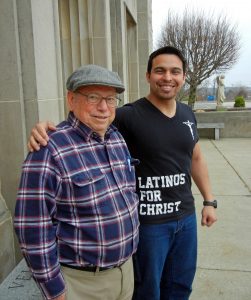
That is the conclusion of Gonzalez and fellow Weirton-based lay minister Salvador Ramirez-Brambila. The two men are part of the resurrection of a Spanish-language Mass in the Ohio Valley, teaming with a retired priest from Ohio for the last year to offer a monthly service at St. Joseph the Worker Roman Catholic Church.
"We've gotten a group as big as 80 and have a steady 30," said Ramirez-Brambila, a graduate of Franciscan University of Steubenville who serves the church as both youth minister and Spanish ministry coordinator.
He said the core of the group is international students from the university, workers associated with some Mexican restaurants in the area and a handful of long-term immigrant families such as Gonzalez's.
Gonzalez, who has a master's degree in theology from Franciscan, said he came to the U.S. in the 1970s, having fled Central America after he was arrested multiple times by a pro-communist government.
He and his young family first lived in Miami, but relocated to the Ohio Valley at the urging of a friend after Hurricane Andrew destroyed their Florida home in 1992.
"Living in Miami, you don't even need to speak English," Gonzalez joked. "When we moved here, it was completely different."
He noted the transition was harder for his wife, whose English is not as fluent as his own, but said he, too, has relished hearing the beauty of his native language and getting together with a group that has a shared cultural history, if not precise nation of origin.
"We were missing that," Gonzalez said.
While Ramirez-Brambila is native speaker of English and California bred -- the son of a Mexican diplomat who immigrated to the Los Angeles area with his wife - he said he has also been moved by the gatherings.
"It kind of revives my mother tongue. It brings me back to my culture," Ramirez-Brambila said of one part of his own response to the services. "There's a bad pride, but this is a good pride."
On the flipside, the soon-to-marry Ramirez-Brambila said the ability to speak Spanish in a group setting and worship in a mix of people from all over the Americas has strengthened his ties to the Ohio Valley.
"It's already home, but it's even more home," he said, noting he is hoping his parents will relocate here for at least the summers.
BRANCHING OUT
For all the roots to which the new service speaks, Ramirez-Brambila said he has been surprised at the diverse ways it is branching out.
Attendees who are of Latino descent are already interested in adding a second monthly service. And, participants are also hoping to work in some potluck dinners, praise and worship services and dedicated Spanish-language prayer times, he said.
But, interestingly, there is also increasing interest among regional residents who are not fluent speakers of Spanish, he added. "It's a great place to practice," he said of attendees who are there primarily to learn the language but also seem to enjoy the charismatic and enthusiastic nature of the Latino-centric service.
Still others, he noted, are there for sheer convenience. Ramirez-Brambila explained the service, which occurs at 2 p.m. on the second Sunday of each month, is preceded by an hour of reconciliation.
Some strictly English-speaking parishioners are tapping into that opportunity for confession simply because the timing is good.
Gonzalez said a similar spirit of unity and cooperation has been on display in the details of making the Spanish Mass work. The actual Mass is said in the Diocese of Wheeling-Charleston by a retired priest, Father John Neiman, from the Diocese of Steubenville.
This kind of thing has happened in the past, he noted. There was a point, about 20 years ago, at which another Spanish-speaking priest who has since relocated to Columbus did Spanish Mass each week -- rotating through such Ohio cities as Steubenville, Cambridge and Marietta. A similar service still occurs monthly in St. Clairsville.
Ramirez-Brambila said there was also a Spanish Mass offered on the West Virginia side of the river when Wheeling University was still connected to the Jesuits and there was a significant Spanish-speaking contingent in the student body.
"This might be the restarting of a dynamic like that," said Ramirez-Brambila, noting the cross-diocesan effort may include workers from the Diocese of Pittsburgh in the future.
MULTI-LINGUAL
While Spanish may be the language need of the day, the archives of the Roman Catholic Diocese of Wheeling-Charleston reveal the Ohio Valley has a long history of conducting services in the language of the people or peoples as the immigration case was.
In Wheeling along, there were several "national" parishes, according to the archives. St. Alphonsus and its early Capuchin priests, many of themselves natives of Germany, celebrated Mass in German until well into the 1900s.
Similarly, the former St. Ladislaus in South Wheeling was a Polish-speaking parish and the former St. Anthony in East Wheeling served the Italians of the city, archive records show. There was also, briefly, a Croatian church, St. Catherine, located in Benwood.
Even today, there are remnants of other earlier immigrant languages that still appear in services in Wheeling churches.
At St. John the Divine Greek Orthodox Church, Father Demitrious Tsikouris said services include brief liturgical responses in Greek, Arabic, Romanian and Slavonic (a Russian liturgical language) that literally speak to parishioners' varied cultural roots.
"The Lord's Prayer ... is typically read in English, Greek and Slavonic," Tsikouris added.
At the nearby Our Lady of Lebanon Maronite Catholic Church, Monsignor Bakhos Chidiac reported that most of their worship is in English, but four parts of each service are in Aramaic, the language Jesus would have used for everyday purposes.