
Unplugged Prayer
Trending
WHEELING -- Deacon Doug Breiding gets it. He's got the smart phone and the computer that's bursting with email. Such are the tools of the trade for a man who oversees every Roman Catholic cemetery in the state.
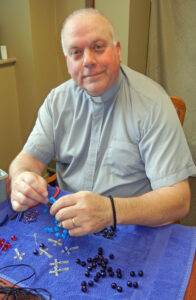
But, Breiding -- whose home base is Mt. Calvary Cemetery in Wheeling -- has also got his rosary. Or, rosaries. There's the knotted-cord chaplet he wears on his wrist, the crucifix-bearing rosary he carries in a pocket, the minimalist strand of prayer beads that hangs from the turn signal in his car and many more.
He doesn't just use the collection as daily prayer tools. Many of the chaplets (a more general term for the prayer aids) and rosaries in his life are among the several hundred that he makes each year to share with others.
"There's a lot of distraction anymore … This is a way of basically being able to pause," he explained of his inspiration. He noted saying a complete rosary prayer at a "reverent pace" takes about 20 minutes.
That pause-button concept particularly appeals to him in the cemetery setting. Some visitors are in deep grief. Some are there to exercise -- trekking a road that winds seemingly ever upward through acres of graves. Regardless of why they're there, he'd like them to ponder.
"This is a cemetery that's consecrated ground," Breiding said. "It should be a prayerful place."
To that end, Breiding has taped multiple free rosaries to the window next to his office door. There are tiny finger rosaries made in Italy and more traditional ones that he, his family and volunteers that he has trained have made from plastic beads. All have been blessed with holy water given Breiding's deacon qualifications.
There's also a packet of pamphlets that provide a sort of Rosary 101. "It's my hope they'll at least say a prayer or two," he said of the display's potentially inspirational effect on cemetery visitors.
SPIRITUAL TOOL KIT
Breiding came to rosary making in his 20s. He now makes several hundred each year -- ranging from simple, beaded chaplets that might be connected with a specific saint to long, knotted prayer ropes more associated with the Eastern Rite and Eastern Orthodox traditions.
He likes both the beadwork and the cording, which can require multiple cross-shaped maneuvers to create a single, bead-shaped knot.
"It's not jewelry making," Breiding noted of the variety of chaplets that he produces. While the skills sets are generally the same, he said his creations are made in sacred conditions in addition to being blessed. "It's a rather involved process."
Whether he's making just a couple of rosaries during some down time or doing a marathon crafting session, Breiding said he sets the atmosphere with prayer. Sometimes, he also listens to Gregorian chants or talks on religious subjects while he works.
He likes both the tradition -- chaplets go at least as far back as the early 1200s -- and the nearly endless varieties the prayer aids can take.
"Traditionally, it's made of wool, it's black … a reminder of being a sheep to the shepherd," he said of some of the oldest forms, some of which would have had red beads to represent Jesus's blood. He makes some of these knotted chaplets -- which can incorporate yardage of cording -- but has purchased others from monasteries.
When more beading and colors are added, the possibilities grow. He makes some small chaplets -- such as a strand of red beads that's color coordinated to his wife's car. Classic rosaries have 59 beads.
Except for special commissions -- for which he asks the cost of supplies and a donation to a church cause -- Breiding is covering the costs of the rosaries and chaplets out of pocket. Most of the giveaway ones are plastic, but have the same beading pattern as ones that are made of precious metals or stones.
"They work the same," he noted.
Regardless of the materials, he said chaplets include either a plain cross (in the knotted versions) or a crucifix (in the beaded versions). The beaded ones typically contain a centerpiece with an image of Jesus on one side and his mother Mary on the other. Some smaller chaplets have a small metal medallion and, sometimes, colors or beading patterns associated with a specific saint.
Latter chaplets might be generally popular figures -- such as St. Anthony, the patron saint of lost things. They might also be chosen because of the chaplet user's profession, Breiding said. For example, the lesser-known St. Callixtus is the patron saint of cemetery workers.
Rosaries can also reflect special types of prayers or events. There's a rosary specific to those who are praying for someone in purgatory, he offered as one example. These strands are color ordered to match the intent of the prayer -- moving from black beads to dark gray to light gray to white.
"I sometimes liken praying the rosary to cutting grass," Breiding said of the age-old rhythm of any of these kinds of prayers. "You can see where you are. There's a definite beginning and a definite ending."
SPIRITUAL ORDER
The orderliness and meditative quality of a prayer tool appeals to Breiding's spirit, he said. Noting that other faiths -- such as Islam and Buddhism -- and some non-Catholic Christians also make use of prayer beads, he added that the rosary brings a rhythm to his spiritual life.
"It makes me keenly aware of how distracted I am," he said.
Part of the focus the chaplets allow is the prayers themselves, he noted. There are multiple possibilities that can be prayed with the same rosary, for example. There are standard prayers known in Catholic shorthand by their opening words -- the "Our Father," the "Hail, Mary" and the "Glory Be."
There are also specific mysteries of the faith that the praying person can reflect upon at certain points of the rosary, he noted. These can be standard themes -- such as the Nativity or the Crucifixion. Or, the mysteries can be coordinated with the days of the week. Sorrowful mysteries -- such as Jesus's agony in the Garden of Gethsemane -- are the traditional focus on Tuesdays and Fridays, for example
The small pamphlet Breiding shares alongside his rosaries is a basic guide to what prayers can be made. But, the serious rosary user can take it to a higher level if desired, he noted. There are whole books dedicated to the possibilities.
Interestingly, Breiding noted that there tends to be a division between the Western and Eastern traditions in terms of to whom those prayers are directed.
"This is an intercessory prayer," Breiding said of Western Catholics using rosaries. "We're asking for the Blessed Mother (or a specific saint in other prayers) to intervene. We're asking her to pray for us just like we do for one another here on earth." Eastern traditions - including Greek or Russian Orthodox Christians - who are using prayer ropes are praying directly to Jesus or God, he added.
While Catholics are not required to pray the rosary, Breiding said most know the general prayers by elementary school. Stringing them together like, well, beads is a decision.
"It takes some practice," Breiding said. "But, so does Nintendo and PlayStation."