
Winter Can Be The Perfect Time To Get Outside
Trending
BELMONT -- Sometimes, Popsicle cold is what makes a good hike, according to John Hickenbottom, a park naturalist for the Ohio Department of Natural Resources.
Hickenbottom, who was visiting Barkcamp State Park in Belmont for the day, couldn't help but check off some reasons that winter is an ideal time to get outside. He started with the bit of pandemic crazy that is affecting parks both large and small.
"It's like people have rediscovered the outside," he said of COVID-19 quarantining, leading to potential crowds on the trails whenever the weather is mild. "Every subsequent summer has been busier than the last."
The off season can also get busy, he said. Jan. 1 events known as First Day Hikes are growing in popularity. And, as many as 6,000 hikers -- that's right, 6,000 -- come out for special events such as a legendary winter hike offered at Hocking Hills State Park, also in Ohio.
"You can't really hike," Hickenbottom joked concerning that raucous, six-mile trek, which involves staggered starts, buses and pancakes and is conducted regardless of weather. (This year's event is scheduled for Jan. 21.) "You basically just corral them onto a trail."
Such season-celebrating events aside, Hickenbottom said calm and quiet trails are more the norm when the temperature dips. And, that means special opportunities, he noted.
"This is a good chance to get to know the park on a more intimate level," he said of learning a trail system or camping in a new place.
He and his wife use this strategy for an annual March hiking trip of their own, he added. They visit various segments of the Appalachian Trail in Virginia and Tennessee -- purposefully beating the spring surge of hikers to the punch.
There's also the way cold and quiet interact with wildlife, he said of the upside of winter hiking. Fewer humans, bare trees and vegetation that is largely reduced to tawny skeletons make it easier to see songbirds, deer and other mammals.
CALIBRATING
"Some people are hardcore," Hickenbottom noted of hikers and even tent campers who are out there in all kinds of weather. Others schedule their winter outdoor time in a way that follows the season's ups and downs.
He's a mix of both. He walks his own 20-acre property every day, either in the morning or the evening depending on his work schedule. And, once a week, all year long, he does a longer hike.
The winter hikes serve critical purposes for him, he noted. Sometimes, it's just a no-agenda way to get his blood flowing.
They also allow him to get out of the house and office, he said. "Everyone starts to go a little crazy in the winter. It's a good chance to get out and get refreshed. The world doesn't stop because it's winter. Nature just changes."
Those changes, however minute, additionally allow him to calibrate his mind to the season. He said he's always looking and listening, such as when a recent warm spell got tiny frogs called spring peepers singing way earlier than normal. Or, at the way the daylight was obviously extending even a couple of weeks after the late-December winter solstice.
"That's really how my internal clock gets set," Hickenbottom said of watching for early signs of spring such as the February blooms of skunk cabbage or vernal pools full of salamanders that are only a few weeks away from forming. "When the first red-winged blackbird shows up, I'm like, 'Oh, spring's coming.'"
How being outdoors affects his thinking is so critical, Hickenbottom noted, he said he once left a full-time parks job that had him behind a desk too much for a part-time position that allowed him to be largely outside. It paid off in the long-term. He's now a full-time naturalist at Salt Fork State Park in Guernsey County.
"I just need it," Hickenbottom said of being outdoors. "I need to see the changes. If I stayed inside, just looking at a calendar, I'd go crazy."
Taking the time to understand what one is seeing -- or photographing -- can make the winter hiking experience an even better one, he added. There are old-school field guides and phone apps that can help hikers identify trees by their bark or buds. Many wildflowers and grasses can be similarly known by their winter skeletons, he said.
Hikers can, alternatively, just look for winter plant activity that stands out, he added. Witch hazel trees generally sport spiky yellow blooms in November, for example. Christmas ferns remain a glossy green throughout the year.
THE DETAILS
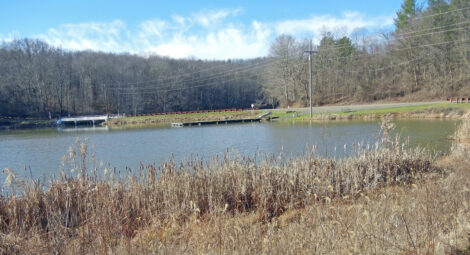
Barkcamp State Park -- formed in the mid 1900s and named for a nearby log-processing facility that stripped bark from harvested trees -- has many miles of trails and a campground that remain open throughout the year.
Trails through this second-growth forest that tops sandstone hills range from fully accessible to moderate in level of difficulty. Length ranges from less than a mile to 8 miles. Certain trails are open to horses, mountain bikers and snowmobiles. Hunters can also use the non-trail portions of the park.
A campground that boasts a vintage barn with Mail Pouch Tobacco signage has full-hookup, electric and tent-only sites. Some sites are accessible. Some accommodate equestrian camping. Other areas are available for group camping. Minimalist cabins are also located in the campground.
Hickenbottom offered one caution for those new to being outdoors in the winter: Don't assume that ticks aren't active. He has seen black-legged ticks -- a vector for Lyme disease -- all year around.