
Wheeling’s Own Lorax
Trending
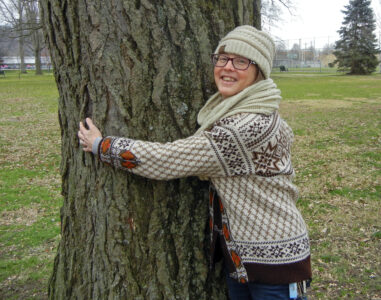
WHEELING -- Karen Cox doesn't just speak for the trees, she listens to them. Right now, the chair of the Municipal Tree Board said some of Wheeling's tallest, greenest and leafiest residents are calling for help.
Indeed, a recent survey the two-year-old advisory board conducted of trees on public land revealed at least two disturbing trends. One: Wheeling's community forest is strong on grand, old trees and an effort is underway to plant young ones here, there and everywhere. But, mid-life trees are fewer and farther between - meaning the senior trees need to hang on while the young'uns mature.
And, two: Some much-loved trees -- such as those that ring Garden Park in Warwood -- are in trouble. They are already elderly, Cox said. Heavy park enjoyment that regularly involves visitors parking their cars on the grass surrounding the trees is compacting the soil to the point the trees' roots are struggling to breathe.
"... Anything that happens to them at this stage in their lives, they're going to struggle to come back from that," Cox said.
SEEING THE FOREST
The soil compaction at Garden Park is a prime example as to how quickly any municipal green space could turn barren, Cox said. "As we get older, we heal more slowly. It's the same with trees."
At Garden Park, many of the trees appear to be about 100 years old, she noted. While species vary -- including oak, red maple, gingko, sycamore and dawn redwood -- that's pretty old for any tree.
An oak in a rural area, she noted, can sometimes reach 300 years of age. An urban oak, in contrast, generally tops out at about 100. Trees on parkland are somewhere in the middle in terms of environment, she added. They have space to spread out roots and generally have access to water. But, they are also exposed to mowing, foot traffic and, in some cases, the weight of cars and heavy equipment.
The soil compaction that results can be a killer, Cox said.
"In an ideal soil, you have 50 percent pore space, which is filled with water and air," explained Cox, who has bachelor's and master's degrees in forestry and is an extension agent for Ohio County. "When soil gets compacted, it takes away that pore space."
While trees are known for getting the carbon dioxide they need from the air through their leaves, their roots also need to pick up oxygen to be healthy, she added. "Tree roots need air to breathe ... If they don't have it, their roots suffocate."
So, when Cox and the Municipal Tree Board surveyed the trees on Wheeling's public lands -- with the exception of Oglebay Park's massive acreage -- it was especially disturbing to calculate the heavy loss of large trees in Wheeling Park that came during a 2022 derecho and to see how many trees at Garden Park are displaying signs of suffocation.
Cox said the latter trees have sent more roots above ground than is normal. It's a desperate search for oxygen, she explained. That, in turn, has exposed tree roots to lawn mower wounds that can allow deadly disease inside.
Complicating the issue, Cox said the majority of the trees all over the city -- not just those at Garden Park -- are seniors. As there are fewer middle-aged trees on public lands -- for whatever reason -- Cox said those elders need to hang on until a fresh round of tree planting literally takes root.
It's going to take more than positive thinking for this to happen, she added, pointing to the potential drastic tree loss looming at Garden Park as a specific example.
"If people in this neighborhood want to keep these trees alive, they need to stop parking in the grass," said Cox, who was recently certified as an arborist through the International Society of Arboriculture.
SEEING GREEN
Is elder care for some trees and the widespread planting of young ones worth the trouble and the expense?
Cox ticks off the studies that suggest it is. People who can see trees out their windows have better mental health. People who shop in tree-lined areas tend to linger and spend more. Also, today's science allowed the Tree Board's recent survey to put dollar amounts on the services specific Wheeling trees provide.
In Garden Park alone, the survey estimated 70 some trees provide more than $16,000 in annual benefits to the community. This figure is based on the trees' handling of greenhouse gases and pollutants, their absorption of storm water, their aesthetic increase to property value and their ability to reduce heating and cooling costs by providing shade in the summer and a windbreak in the winter.
For the overall city -- again, excluding Oglebay Park -- the survey estimated about 1,200 trees on public land are providing nearly $161,000 of benefits. (Readers interested in more detail can visit the survey at https://wheelingwv.treekeepersoftware.com/.)
In the long haul, Cox hopes the city will heed the board's advice and bring on the love where it needs to and plant like it means it everywhere else. She's also hoping private landowners will do their part to keep Wheeling green -- perhaps planting a tree during upcoming Arbor Day or Earth Day activities.
While the Tree Board has no role concerning privately owned trees, Cox said the group is happy to advise and educate on such issues as the negatives associated with the topping method of pruning, the benefits of lawn aeration, how to plant a tree well and how homeowners can select a tree that will flourish in a specific space.
The mayoral-appointed Municipal Tree Board meets 11 a.m. on the first Thursday of each month at the Ohio County Public Library. The public and prospective board members are welcome.