
THE PLANTSMAN
Trending
By NORA EDINGER
For the Sunday News-Register
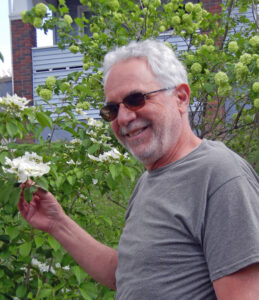
WHEELING -- There are gardeners and there are plantsmen. Larry Helgerman moved from the first category to the second quite some time ago. Part of the intensification involved meeting a daylily specialist who was a neighbor in the Pittsburgh suburb he then called home.
"I got into the daylilies when I was in Mount Lebanon. I had maybe five or 10 varieties. That seemed pretty good for one garden," said Helgerman. "I had a friend up the street who was also a plantsman ... He started telling me about this lady who was our neighbor who raised daylilies and sold daylilies also."
The lady turned out to be Barbara Dittmer, a regional leader in the American Daylily Society. She grew 450 kinds of daylilies. There were lemony yellows, reds, peaches, blooms so dark they approached black. Helgerman was gobsmacked -- and hooked.
"We became friends and I started collecting off of her," he said. When Dittmer and her husband decided to retire and relocate, "I ended up buying about a quarter of her garden."
Ninety varieties came with Helgerman to Wheeling, when he moved here to marry Mary Grey. Their local property is smaller than his former Pennsylvania digs, but the plantsman now has about 125 types of daylily.
LOCATION, LOCATION
And -- as part of his plantsman style -- each one of them is labeled, mapped and charted in two ways. One chart is by variety -- a list that includes details on flower color and shape, the name and location of the hybridizer and how much sunlight or shade the plant needs.
The other is height oriented. This chart comes in handy as Helgerman prefers an informal, cottage-style garden -- the tall ones in the back of the pack.
"You have to (do this) if you have that many and you want to keep them organized," Helgerman said. He noted he learned a bit of that the hard way when his original Mount Lebanon gardening friend died suddenly - without leaving a plant map or tags.
"Now I have some daylilies of his," Helgerman said. "I have his raw list, but I've been trying to figure it out ... When you have 80,000 (overall varieties), the differences can be really subtle."
COLOR EXPLOSION
Helgerman noted that daylilies -- which aren't technically lilies despite their name -- started out as about 20 species in their native Asia. Hybridizers started tinkering with the plants in the late 1800s, he said, leading to those 80,000 some varieties.
While the choices are so abundant that Helgerman hasn't felt inclined to start hybridizing on his own, he said he enjoys the broad variety of petal shapes, textures and colors that have resulted.
He particularly admires the work of an Arkansas woman, Pauline Henry, who was most active in the mid 1900s. Her varieties carry the word Siloam in their names as an indicator of her location.
He's less dazzled by some of the newest types, however. "Some of them are odd and have splotches," he said. "I like the more traditional varieties."
Come late June and July, a bevy of such classics will be the showstopper in a garden that has many other shrub and flower accents, including a stone wall that will soon be covered with orchids. "Every time they come up, they're just all beautiful," Helgerman said of the daylilies, adding that he doesn't really have a favorite. "I enjoy them all."
ANIMAL PATROL
As do the deer, unfortunately, he noted.
Helgerman is less about physical barriers than chemical ones.
He said he has been using an essential-oil product called Deer Stopper successfully for the last several years. During the peak blooming season, he sometimes sprays it on a daily basis, mixing his own solution from concentrate to keep costs down.
"I just want to see the show," he said of being willing to spray as often as needed, in addition to fertilizing the daylilies and making sure they get plenty of water in the spring. "Occasionally, I (still) get a nip here or there."
On the animal flipside, Helgerman puts out the doormat for bees given the depth and breadth of his garden's pollination needs.
In late April, a colony of mild-mannered mason bees was already lazily buzzing in and out of a slice of tree trunk that Helgerman had drilled full of holes and hung under the eaves in order to provide them a home base.
"They're super pollinators," he explained of choosing them over honey bees. "They can visit up to 2,500 flowers a day."