
Trending
WHEELING -- Given a mix of seemingly endless construction downtown and Ferris-Bueller-day-off weather, it might be time to stop, get out of the car and look around a bit.
Wheeling's streets are waiting, with stories that play out block by block when they are viewed at human speed, according to Betsy Sweeny, architectural preservationist and a spokesperson for Wheeling Heritage.
"It's a fun way to read the history that happened in Wheeling, particularly in the downtown," Sweeny said of slowing down for a closer look at architectural details in particular.
For example, the Professional Building on Market Street was originally the City Bank Building. Sweeny sees its architecture as a nod to fortress and castle themes -- all the better place to keep one's money safe.
Not only does each building have a story, she said the entire downtown has a narrative that explains how the city developed. It's largely a Victorian tale, she added.
"When you're thinking about architecture around Wheeling and, particularly, downtown, you can really see what was happening at about the turn of the (20th) century," Sweeny said. "Some buildings are a little older and some are a little younger, but they're mostly about 100 years old."
Downtown tells of civic pride and dramatic destination -- with large churches, theaters, banks and government buildings, she explained.
Centre Market was more about everyday business, with shop owners selling wares of every sort on the first floors of buildings that ring the large marketplace.
"There's a reason why those upstairs floors are convenient to turn into apartments," Sweeny added of such buildings. "People have always been living there."
South Wheeling, in turn, has an abundance of housing built for laborers and remnants of the city's massive manufacturing past.
In addition to these overall development markers, Sweeny said she enjoys looking for "ghost signs."
Some are painted on buildings. Some are literally carved into stone. Finding them can be a treasure hunt of sorts -- especially if history enthusiasts follow up with building descriptions that can be found on the Ohio County Public Library website.
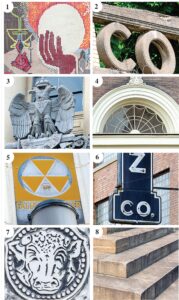
Readers who would like to do a history hunt of their own -- without leaving their armchair -- might enjoy trying to identify the photos that accompany today's story. Where in Wheeling was each image taken? Answers appear below.
Block by Block Answer Key:
1. Part of the mosaic at the former Columbia Gas Building, at 44 16th St. The mid-century modern building is currently in redevelopment.
2. Part of original signage at the former Lincoln High School, a school for African Americans until segregation ended in 1954. The 1000 Chapline St. building now houses the Ronald C. Mulholland Juvenile Center.
3. The recently restored eagle at the Scottish Rite Cathedral at 84 14th St. The fraternal lodge headquarters was tagged for redevelopment but is currently in bankruptcy proceedings.
4. A spider web window at the recently restored Fort Henry Club at the corner of 14th and Chapline streets. The building was originally a private residence.
5. A relic of the Cold War, a nuclear fallout shelter sign on the Central Union building at 14th and Market street announces space for more than 1,000 Wheelingites. The building is now part of the Bank Plaza complex operated by WesBanco.
6. Part of the Cooey-Bentz Co. furniture store sign at 36th and Jacob streets in South Wheeling. The store is remembered for annual Santa visits.
7. An image repeated on the doors of a fully restored Centre Market --between 22nd and 23rd streets -- recalls the site's agricultural past.
8. The steps outside Independence Hall at the corner of 16th and Market streets. Once a multi-faceted government building bustling with people, it is now a museum that focuses on the Civil War West Virginia's path to statehood.