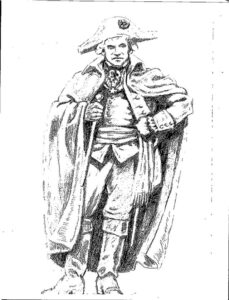
Dr. Robert Hazlett Left Permanent Mark on Wheeling
Editor’s Note: This article is part of a series featuring Civil War veterans with Wheeling connections. The series will lead up to the planned move of Wheeling’s “Soldiers and Sailors Monument” from Wheeling Park to the side yard of West Virginia Independence Hall.
By Anne Foreman Hazlett,
Great Granddaughter of Dr. Hazlett
Robert W. Hazlett’s long career as physician, devoted father and civic leader left a permanent mark on the Wheeling community he adopted as a young man. His grandfather, Robert, was born in Coleraine, Ireland in 1756. He married Mary Colwell, whose mother, Catherine, was a French Huguenot who had fled to Ireland. According to family records, Mary was “remarkable for her personal beauty and great force of character.” They came to this country about 1785 and moved to Washington, Pa, from Carlisle, Pa, in 1795. Their eighth child was Samuel Hazlett who married Sara Johns.
Robert W. was the third child of this union, born on April 16, 1828 in Washington, Pa. The “W” stood for nothing. The family lore is that he thought it seemed more dignified to have a middle initial. He was educated at Washington College (Now W&J). He exhibited a talent for drawing and an interest in medicine early in his college career. One of his professors, Dr. James King, appreciated his enthusiasm and asked him to prepare specimens and illustrations for his lectures on anatomy and physiology.
He moved to Wheeling to study medicine with his cousin, Robert Hazlett Cummins, whose home and office were on Fourth St. (now Chapline Street). The house still stands today as part of the Kepner Funeral Home complex.
Hazlett received his MD from Jefferson Medical College, Philadelphia, in 1851. He returned to Wheeling where he married Mary Elizabeth Hobbs in 1852. She was a native of Massachusetts, born on Sept. 23,1829, in Cambridge. Her father, John Hobbs was the founder of the Hobbs Glass Co. in Wheeling which later became the Hobbs-Brockunier Glass Co., famous for its “Peachblow” colored glass.
Mary and Robert had eight children, five of whom survived to adulthood. Charles lived a year, twins William and John lived only a few days. Howard, Edward, Samuel, Robert and Katherine were born between 1853 and 1867.
Dr. Hazlett practiced medicine in Wheeling until the winter of 1857-58 when ill health forced him to leave his practice. Ever restless and inquisitive, he chose to use this time to hike over the hills and mountains of West Virginia, in the process making his own geological survey of the coal fields of counties east of the Appalachian Range. It was during this time that he located and supervised the drilling of the first oil well in what is now West Virginia. He also discovered a huge stratum of coal at Richie.
His health restored, he returned to Wheeling and resumed his medical practice only to leave once again when the Civil War erupted. He joined the 2nd Virginia Volunteer Infantry as a surgeon, being commissioned in June, 1861. He was a member of the “Grafton Guards” as they were called, led by Captain George R. Latham, and saw action in the battles of Monterey, McDowell, Cross Keys, Cedar Mountain, White Sulphur Springs, Warranton, Freeman’s Ford, Second Bull Run, Centerville and Chantilly. Many years ago, his amputation kit was donated to OVMC by his grandson, James C. Hazlett, MD. It is still on display in the main lobby.
He resigned in 1863 and was appointed one of the surgeons of the U.S. general hospital at Grafton, W.Va. He was later appointed by the Secretary of War as surgeon of the board of enrollment of the first district of West Virginia. His cousin, Charles Hazlett, graduate of West Point Military Academy, was killed as he commanded an artillery battery atop Little Round Top in Gettysburg (Hazlett’s Battery).
Hazlett was extremely successful in his practice of medicine and was able to do so for a total of almost 50 years. He was active in community affairs, serving on city council and the board of education.
He served as examining surgeon for pensions for the United States government. He was a director of the National Bank of West Virginia at Wheeling, as well as director of the Wheeling and Belmont Bridge Co. He served as president of the city and county medical societies and, in 1893, was elected president of the State Medical Society.
His office and home had been on Jacob Street, South Wheeling, for many years. After retiring in 1880, he moved to a house he built at 921 Main St., now home to the Friends of Wheeling Inc. It is a brick residence built in the Second Empire style with many beautiful Queen Anne details in the interior.
He died at his home in 1899 after suffering for a year with pernicious anemia.
His widow, Mary, died in 1901 in Wheeling. Their son, Robert, married Anne Cummins in 1909 and raised three children in the house until moving “out the Pike” in 1926.
My father, James, who was Robert and Anne’s second son, had fond memories of the home on Main Street. The sun porch addition to the back of the structure was his favorite place. He was able to watch the trains as they passed below his home on the river. He never knew his grandfather. His mother, when cleaning out the attic many years after they moved from Main Street, threw Robert W.’s Union Army Uniform away, saying it smelled musty. I’m not sure my father ever got over that loss. His grandfather’s green silk medical sash and major’s shoulder patches survived that purge and are shown in the photograph.
Following his death, at a meeting of the Ohio County Medical Society, Dr. S.L. Jepson eulogized R.W. Hazlett: “I have known him for 30 years, and in all that period and under all circumstances his conduct as a gentleman shone forth. As a physician, he always ranked among the best … He was dignified and courtly in manner. He lived up to the code of ethics of the profession. He was in every sense of the word an honorable man, in both his private and public career.”
Community
Students Pitch In to Get Shadyside Ready for Loop Festival
Marshall BOE Gets Update on Future New Riverside Elementary School
Former Fire Chief Faces August Jury Trial
ST. CLAIRSVILLE — A trial date has been set for former Martins Ferry volunteer fire chief William ...
Recovery Advocacy Group Presents Funding Request to Brooke Commission
Brooke High School Class of 2026
The following is the Brooke High School graduating class of 2026. This list was not available by deadline of our ...