Role of Conservation District Supervisor Explained
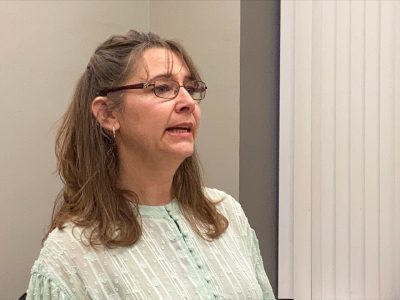
AMY WADE
Races for conservation district supervisor will be near the bottom of the ballot when West Virginia voters go to the polls in the May 10 primary election.
Most people likely don’t know much about the position or what its duties entails, and this week Ohio County Conservation District Supervisor Amy Wade explained the conservation district’s role to county commissioners.
“We refer to ourselves as the local boots on the ground,” she said. “We are the ones who know the people around us, and the lay of the land. We’re the ones people can call and say, ‘I have this problem.'”
In short, conservation district members work to encourage best land management practices.
One of these is the implementation of exclusion fencing on farm properties to keep livestock out of the watershed. The animals take the soil with them when they leave, Wade explained.
“And they’re not just drinking when they are in there,” she said. “As that water carries, it is carrying everything else with it.”
Rotational grazing is also emphasized by members, Wade added. This is the practice of fencing farmland into smaller distinct areas, and moving livestock from one to another after a period of time to prevent erosion.
The Northern Panhandle Conservation District also oversees local watershed dams, which are affected by water and soil erosion.
The district comprises Hancock, Brooke, Ohio and Marshall counties, and two supervisors are elected from each county to serve four-year terms. Wade is not up for election this year, and her Ohio County colleague Bob Luchetti Sr. did not file for re-election. Bob Luchetti Jr. is the only candidate seeking the office in Ohio County this year.
Presently serving with the Northern Panhandle Conservation District are Jim Anderson and Chuck Glenn representing Hancock County; Britney Hervey-Farris and Steve Paull from Brooke County; and David McCardle and Mark Fitzsimmons from Marshall County.
Wade told commissioners the idea for conservation districts was born out of the dust bowls that resulted throughout the U.S. during the 1930s. In the midwest, all seemed well for farmers during prior years. Tractors were just becoming available to farmers, who looked to buy more land “as crop prices were really high,” Wade explained.
Then came a tremendous drought, and farmers had no crops to sell. What food was on the vine largely was left to rot.
“We ended up with a perfect storm that created a perfect disaster in terms of soil,” she explained.
Soil conservation pioneer Hugh Hammond Bennett convinced federal officials to create the Soil Conservation Service, now known as the Natural Resources Conservation Service. The goal of the agency is to teach the public how best to take care of soil.
From each county, one supervisor is selected to serve on its solid waste authority, and in Ohio County one is also chosen to serve on the County Watershed Commission. The agency partners with such other environmentally conscious organizations as the West Virginia University Extension, the West Virginia Division of Forestry, the Farm Service Agency and the West Virginia Conservation Agency.
Community
Students Pitch In to Get Shadyside Ready for Loop Festival
Marshall BOE Gets Update on Future New Riverside Elementary School
Former Fire Chief Faces August Jury Trial
ST. CLAIRSVILLE — A trial date has been set for former Martins Ferry volunteer fire chief William ...
Recovery Advocacy Group Presents Funding Request to Brooke Commission
Brooke High School Class of 2026
The following is the Brooke High School graduating class of 2026. This list was not available by deadline of our ...