Shell Chemical Appalachia Rep Talks Pennsylvania Ethane Cracker
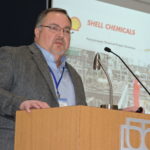
Photo by Janell Hunter Jim Sewell, environmental manager for Shell Chemical Appalachia, speaks Thursday to the Ohio Valley Oil and Gas Association in St. Clairsville.
ST. CLAIRSVILLE — Jim Sewell, environmental manager for Shell Chemical Appalachia, shared information with the Ohio Valley Oil and Gas Association about the giant ethane cracker, which the subsidiary of Royal Dutch Shell is building at Monaca, Pa.
The association is a network of community members who benefit directly or indirectly from the oil and natural gas industry.
Association President A.J. Smith said the organization invited Sewell to help provide an overview of the project, while allowing for a comparison to the potential PTT Global Chemical ethane cracker plant at Dilles Bottom.
“Everyone that is here tonight will be able to draw their own conclusion as to how what is happening up there may compare to what the cracker plant in Belmont County will look like,” Smith said.
Ed Mowrer works in energy programs at Belmont College and also serves on the association’s board of directors.
“We are so excited about the cracker plant that could supposedly come to Belmont County and to hear about what is going on at the plant in Monaca, only 70 miles away. It is a leading indicator of what could happen here,” Mowrer said. “Just recently, I attended a conference where they presented that with the amount of ethane that’s being produced by our local wells. There is room for three more crackers. So this is just the tip of the iceberg. We are very optimistic about economic development in the area.”
Sewell said Shell chose Monaca, Pa. for the location for the plant because of the abundant supply of ethane and because of available transportation infrastructure: water, roads and railways.
The plant will manufacture 50 different products, all types of plastics for manufacturing.
“Another reason this location is so good is because 70 percent of our end-users of the product are within a 700 mile radius of the plant,” Sewell said.
The plant received its first environmental construction permits in June 2015 and immediately began site redevelopment. The location originally housed the Horsehead Corp. zinc smelting operation, and also a lead smelter, so Shell had to assume liability for cleaning up the site to comply with Pennsylvania environmental standards.
Site redevelopment continues, with 300 to 400 people employed on the site per day. Completed parts of the project include construction of a heavy haul bridge so construction traffic does not have to cross an active highway; relocation of Pa. 18 and the Interstate 376 interchange; relocation of railroad tracks; construction of two new docks on the Ohio River; demolition of the old smelting plant; groundwater monitoring; recycling of land according to Pennsylvania environmental laws; creation of an offsite wetland in Washington County; and construction of underground utilities, piping, and auxiliary buildings.
After the initial site development and “real construction” begins, Sewell expects employment on the site to range between 6,000 and 10,000 workers.
Sewell said there have been challenges with regulations, but the company has been able to meet all the challenges by remaining transparent and a “good neighbor” to the community.
The original vision for the project began taking shape in 2010, according to Sewell.
“It has been going for a long time. It is great to see this project take shape. This project has outlasted many other Shell projects. It is a very important project for Shell,” Sewell said.
Asked by an audience member about what he thought was the economic impact of the project, he replied, “I will tell you my view on it, and it is not dollars and cents because I can’t talk about that as an environmental manager. But every Tuesday and also quarterly, we have safety meetings. All the contractors, whether they are in the office working or out moving dirt or putting in pipes or piles, they all show up in the tents for the safety meeting. There are 400 people in that tent. … When you sit there and you see, and it’s only 400 people, that is still a huge economic impact. Some of those people are coming over from Ohio, and some from an hour away, but a lot of them are coming locally. To me, that’s amazing. Six thousand people — that’s going to be a big tent.”
Recently, officials with Thailand-based PTT said they would wait until the end of 2017 to make a final decision on whether to build the comparable giant plant, which would cover about 500 acres along the Ohio River at Dilles Bottom.
Top Headlines
Update: 2 Dead, 19 Hospitalized After Chemical Incident In Kanawha County

Iran fires on 3 ships in the Strait of Hormuz as US maintains blockade and diplomacy stalls

Trump Says The U.S. Will Extend Its Ceasefire With Iran At Pakistan’s Request

Capitol Building Commission Re-Approves Capitol Murals In Special Meeting

Candidates pitch economic ideas, youth retention at ‘Voting For Business’ forum