
Former Tech CEO, Next Marshall President Brad Smith Is Walking the Walk in West Virginia
Trending
CHARLESTON -- Brad Smith, a West Virginia native and successful businessman, has spent the last seven months enticing remote workers to call the Mountain State home.
But it's not just a philanthropic endeavor from a former native son.
Smith is walking the walk by returning to the state.
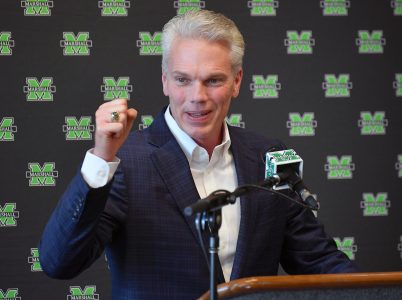
Not only is Smith using his wealth to help develop entrepreneurship across the state in cooperation with communities and institutions of higher education, Smith also is leaving Silicon Valley and returning to West Virginia to take the reins as the 38th president of Marshall University in Huntington.
Smith held a briefing with West Virginia reporters Friday, joined by state and local officials and two remote workers who signed onto their Ascend West Virginia program.
"We all know West Virginia has amazing assets. We have tremendous outdoor resources. We have incredible mountain communities. We have phenomenally talented people," Smith said. "There's been a lot of collaboration between universities, between the private industry, between people who've lived in West Virginia that moved away. And we've all been leaning in to craft this broad architecture of how to reset west Virginia's economy to build on a strong foundation, but to also unlock entrepreneurism."
Started in April with support from Gov. Jim Justice, Ascend is an incentive program that gives $12,000 to remote workers who relocate to West Virginia to live and work. Focused on three host cities, Morgantown, Shepherdstown and Lewisburg, Ascend also awards remote workers with a year's worth of free outdoor recreational opportunities donated by resorts and outfitters.
Despite the involvement and support of state agencies and West Virginia University, the program is privately funded by the Smiths, who donated $25 million last year to kickstart the Brad and Alys Smith Outdoor Economic Development Collaborative at WVU. The collaborative also works on ways to promote the state's many outdoor recreation and tourism opportunities.
Ascend announced its first 53 class members in September, representing just 1% of the total number of applicants to the program. Selectees come from 21 states and Washington, D.C., and as far away as Germany. Counting spouses and children, 110 people will come to the Morgantown area for the first Ascend group, with the average salary for selectees coming in at $105,000 per year.
One of those people is Quintina Mengyan, director of customer experience for Vivid Seats. Mengyan spent the last 10 years in Chicago before deciding to head to the hills of West Virginia.
"I'm a proud Ascender and very excited to be part of the first group in Morgantown," Mengyan said. "I'm participating to expand my experience and appreciate a new place to live and improve my work-life balance."
Matthew Worden, a system architect at Danfoss relocating from Tallahassee, Florida, is a West Virginia native returning home to participate in Ascend.
"My job took me out of the state for a few years, so with the new nature of remote work and the Ascend West Virginia program, I was able to bring my wife and three children back to the state of West Virginia. We love outdoor life. The few weeks we've been here, the family atmosphere has just been outstanding."
Smith said the COVID-19 pandemic showed more work can be remotely done, with nearly one-third of the jobs in the U.S. able to be remotely done. The pandemic also made young adults rethink living in cramped cities, with "rural" becoming the new "urban."
"(Ascend) is the nation's premier talent recruitment program," Smith said. "What it is designed to do is to address historically strategic challenges our state has had about capitalizing on secular trends that will allow us to reposition ourselves to participate in areas we couldn't anticipate in the past... We don't think those were insurmountable. And in fact, we now have secular trends that allow us to tip the odds in our favor.
FROM KENOVA TO SILICON VALLEY
Smith, a native of Kenova in Wayne County and a 1986 graduate of Marshall University, is the former CEO of Intuit, a financial and communications software company with products such as Turbotax, Quickbooks, Mint, Credit Karma and Mailchimp. Smith is chairman of Intuit's Board of Directors, chairman of the board of directors at Nordstrom's and a board member for Momentive, formerly known as Survey Monkey.
Smith led Intuit as CEO for 11 years from 2008 to 2019 after arriving at the company in 2003 and working his way up the corporate ladder. After leaving Intuit, Brad and Aly Smith founded The Wing 2 Wing Foundation, which is focused on fostering entrepreneurship in communities with depressed economies.
It's that desire to help spur an economic development and entrepreneurship revolution in West Virginia that keeps bringing him back home. In 2019, Smith helped launch Intuit's Prosperity Hub in downtown Bluefield in Mercer County along the West Virginia/Virginia border. Bluefield was selected out of 900 different communities across the U.S. Intuit's goal is to create between 200 and 500 jobs at the hub, which provides software support for its products and resources for businesses.
Long after receiving his bachelor's degree from Marshall, Smith continued to give back to his alma mater, donating more than $35 million to the university over the years, setting up scholarships for students, and giving to the university's business programs. Marshall's Brad D. Smith Schools of Business was named for him, as is the Brad D. Smith Business Incubator in downtown Huntington.
On Oct. 28, the Marshall University Board of Governors named Smith as its 38th president. Smith was chosen out of five candidates for the job to succeed Jerome Gilbert, who will leave in December and continue as an adviser to the university into 2022.
"With President-elect Smith at the helm, I know Marshall University has a bright future ahead of it," Gilbert said. "It is truly my pleasure to congratulate you, Brad. You are going to lead the greatest university in the nation, with the greatest people, in the greatest community."
"Brad Smith is undoubtedly the right person, at the right place and at the right time to lead Marshall University as our next president," said Patrick J. Farrell, chairman of Marshall's Board of Governors. "As the search concluded, we discovered there is only one Brad Smith, only one is a Son of Marshall, and only one had seemingly been preparing his whole life for just this moment."
COLLABORATION IS KEY
Smith sees the economic development model he is helping create with Ascend helping bring workers to the state first, with the companies following. Traditional economic development focuses on recruiting large companies and manufacturers, often using tax breaks and special incentives. Smith believes that by recruiting remote workers from dozens of companies, those companies might take notice.
"As soon as employees start to say, 'I want to live in West Virginia for these reasons,' then other employees hear about their fellow employee and say, 'I'm going to go there too,'" Smith said. "Eventually, these companies say, 'why are all my employees wanting to live in West Virginia? Maybe I should open a satellite office there.' But it's not just going to be one pharmaceutical company. It's going to be dozens of companies."
By creating hubs such as the ones in Morgantown, Lewisburg and Shepherdstown, it puts employees from multiple companies together where they can start to work on new ideas together, create businesses and products, and grow entrepreneurship. Smith wants to see the Ascend idea grow into all 55 counties, especially once the state and local governments utilize their COVID-19 relief dollars for broadband expansion, particularly in unserved areas and rural West Virginia.
"I think this gives us an ability to not only attract the talent from multiple companies, but have these companies then have more interest in West Virginia and also have those individuals begin to create companies of their own," Smith said. "That's really the flywheel effect that we talk about."
Even remote workers who didn't make the cut for the first Ascend class were given personalized videos, West Virginia wildflower seeds and $2,500 discount on a mortgage through Rocket Mortgage for those who would still move to West Virginia to thank the nearly 400,000 people who visited the Ascend website and the nearly 10,000 who applied for the program. Smith said nearly two dozen applicants took that offer.
"That's kind of how we're trying to help the rural communities. Shaping a whole new narrative, getting people to come in and live here. And then ultimately come and pick the corner you want to live in," Smith said.
Smith said the key to moving forward is for everyone working together to make the climb, including Marshall University, WVU, the state's entire higher education system, state and local officials and more.
"We have such an opportunity, but we have to all play our part in the orchestra," Smith said. "As I've said many times, whether it's broadband or it's education, we need an orchestra conductor and a sheet of music. And then some of us will play drums and saxophones and trumpets. But if we're all playing the same music, then West Virginia is going to basically entertain the rest of the world with all of its beauty."