Region Leaders Tackle Workforce Challenges
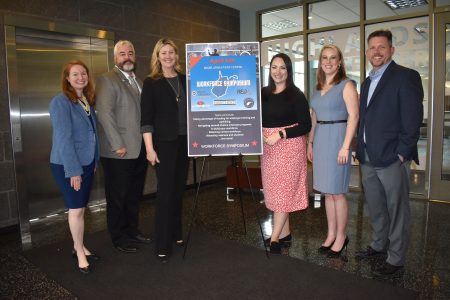
TRIADELPHIA — A who’s who of local, regional and state leaders gathered Wednesday at the Highlands Events Center to collectively brainstorm ways to tackle labor shortage issues and other current workforce-related challenges.
Wednesday’s Workforce Symposium brought together a host of employers from the area as well as representatives of economic development, commerce, education, community service and legislative entities. The symposium was presented by the Marshall County Chamber of Commerce, Wheeling Area Chamber of Commerce, West Virginia Northern Community College, RED: Regional Economic Development Partnership and the West Virginia Department of Economic Development.
“We got everyone around the table to start having conversations about how we could support the business and industrial community,” said Dr. Phil Klein, vice president of economic and workforce development at WVNCC, the lead sponsor for the symposium. “We recognized that there was a workforce shortage and that we didn’t have a pipeline of employees for the employers who needed them. So we started brainstorming and strategizing how we could get people in the same room to discuss that shortfall and how we could support the businesses to grow that workforce.”
Hiring managers and human resource professionals from Northern Panhandle businesses and entities filled the events center to listen and to share ideas on workforce development initiatives. Representatives from major employers like Oglebay to regional entities like Jobs and Hope West Virginia and the American Heart Association, joined officials from the city of Wheeling, Marshall County Schools, the West Virginia Council for Community and Technical College Education and Project BEST at the symposium, along with many other community leaders.
“The purpose of the symposium was to get together with stakeholders from the workforce environment and start a dialogue about how we prepare, train, recruit and retain employees for businesses,” said Dr. Daniel Mosser, president of WVNCC, “given what’s going on in the workforce currently with COVID and the great resignation that took place.”
Mosser noted that millions of workers resigned during the era of COVID-19, and what has followed as society emerges from the pandemic is a whole new dynamic to workforce availability and needs. There have been major demographic shifts, and the majority of Baby Boomers have gotten to the age where they have moved out of the workforce, contributing to a huge void in workers.
“Even the number of people who are entering the workforce is going down and is projected to go down through 2025 — including the numbers of people coming out of high school,” Mosser said. “So the shortage we’re seeing today that most people associate with COVID isn’t a temporary little shift — it’s permanent. It’s going to be with us for a long time, and we’re going to have to think more strategically about our workforce, about where our workers are going to come from, the competition for workers is going to be stronger than it’s ever been.”
For more than a year now, there have been widespread reports of job openings with no workers to fill them, officials stressed.
“We have to start thinking more strategically to get young people into the pipeline, and once they are in the pipeline – get them trained and get them placed in employment and retain them.”
Part of the goals and objectives of agencies like Project BEST are to build awareness of apprenticeship programs that are available in the area – programs that can help redirect a pool of skilled workers into available, living-wage jobs locally.
“We all have workforce issues, so the idea is to take the issue head-on and provide to employers the resources available,” said Erikka Storch, executive director of Project BEST, noting that the local apprenticeship programs are federally certified and give people the opportunity to “earn while they learn or learn while they earn.”
There is some classroom training to these programs, but much of it is on-the-job training where an apprentice is paired with an appropriate number per trade of journeymen.
“So they have the ability to ask questions,” Storch said. “They start contributing to a pension and to health and welfare funds while earning a livable wage.”
While officials are not attempting to dissuade students from going to college, there is a growing emphasis on the need to raise awareness about skilled trades and the availability of these oftentimes well-compensated and much-needed jobs to be filled. Many people have come to realize that college may not be the ideal path for a lot of students, but there are other paths to take that may be better suited for certain workers, Storch noted.
“We want to make sure you’re aware of the opportunities, that you can earn a great wage to support yourself and your family, and that you don’t have to come out of school with tens of thousands of dollars worth of student loan debt,” she said. “A lot of students enter college and find out it’s not a good fit for them, then have to backtrack and have debt to carry.”