
Justice: Special Session Should Never Have Paused
Trending
CHARLESTON -- The West Virginia House of Delegates plans to briefly resume the paused special session next week, the state Senate said they're not ready to resume, and Gov. Jim Justice said Tuesday the special session never should have been paused.
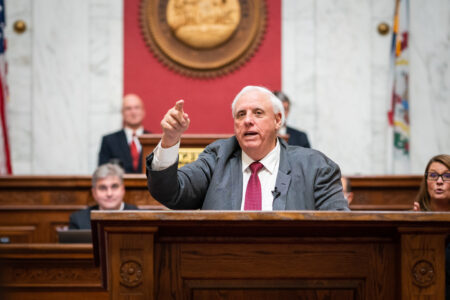
Justice weighed in on the issues Tuesday morning during a virtual briefing with reporters from the State Capitol Building.
Justice called the special session on July 25 to consider his 10% personal income tax cut spread out among all six tax brackets, also adding consideration of a bill to modernize and clarify West Virginia's ban on abortion. But the special session was paused on July 29 after Senate Republicans refused to consider the income tax cut plan and after it made changes to the abortion bill that House Republicans did not agree with.
"Why are we not in session and why are we are we not really dealing right now with the personal income tax, and why are we not dealing with the life issue?" Justice asked.
"I absolutely believe that from our taxpayers' standpoint, from the so-called life issue standpoint, we ought to be here, and we ought to be making decisions and we ought to be moving on down the road."
Justice accused lawmakers of being less concerned about finishing the special session and more concerned about winning reelection Tuesday, Nov. 8, when voters head to the polls on Election Day
"The reason we're not doing that is we have an election in November. That's the reason we're not doing it. For God's sake of living, we're here not to be first and foremost running for reelection or running for office. We're here to do a job," Justice said.
Justice amended his special session proclamation to consider his personal income tax cut plan, asking the Legislature to clarify and modernize the state's abortion laws after the U.S. Supreme Court reversed two previous high court decisions that gave women the right to abortion access. A circuit court in Kanawha County issued a preliminary injunction against the felony abortion law, which dates back to the mid-1800s, allowing abortions in the state to continue up to 20 weeks of gestation.
"We're absolutely sitting on our hands," Justice said. "What are we going to do, sit on our hands until after November? What's happening now? There may be a lot of not good stuff happening right now."
According to a poll released Tuesday by the West Virginia Chamber of Commerce and conducted by North Star Star Opinion Research, 51% of the 600 voters polled said they are pro-life while 45% consider themselves pro-choice, but only 18% of respondents believe abortion should be legal in all circumstances while only 13% said it should be completely illegal in all circumstances.
When broken down by party, 77% of Republican respondents said they were more pro-life than pro-choice. However, less than one in five Republican respondents said they would support an abortion law that did not include exceptions for rape, incest, and the life of the mother.
Both the House and Senate adjourned on July 29 subject to recall by legislative leaders after the House of Delegates refused to concur with changes the Senate made to House Bill 302 - the abortion bill -- including eliminating updated provisions keeping in place a felony charge for medical professionals who conduct abortions outside the very limited exceptions included in the bill.
The Senate gaveled out before taking up the House message and appointing a conference committee to work out differences between the two bodies. House Speaker Roger Hanshaw, R-Clay, issued a press release Friday calling the House back into special session Monday, Sept. 13, coinciding with legislative interim meetings. Senate President Craig Blair, R-Berkeley, said the Senate would not be resuming the special session.
"Make no mistake, I am in complete support of passing legislation to save as many unborn babies as possible," Blair said in a statement last week. "However, I will not cause further chaos and disruption to the process, or burden our taxpayers with unnecessary expenses, by calling Senators back into session without a concrete plan for producing a bill that has the votes to pass both chambers."
Speaking on WV MetroNews Talkline with host Hoppy Kercheval, Hanshaw said the House was only gaveling in long enough to appoint its five members to the conference committee and gaveling back out.
"We're here anyway," Hanshaw said. "It's the next step the House would have to take in order to advance getting that bill to conclusion. Our members just want to be sure we're taking our steps to move that bill to conclusion administratively on our end."
During the special session, Senate Republicans refused to take up HB 301, Justice's income tax cut. Instead, they adopted a resolution laying out a plan to eliminate six categories of tangible personal property taxes if voters adopted Amendment 2 in November, giving lawmakers the authority to reduce or eliminate tangible personal property taxes, such as motor vehicle, machinery, and inventory taxes.
Senate Republicans want to replace that revenue, used by county governments and school systems, with funding directly from the general revenue budget using surplus revenue from maintaining a flat budget the last several years combined with natural growth in tax revenue. Justice has been a vocal opponent of this plan, preferring to provide direct relief to all taxpayers with a personal income tax cut.
"We should not be blocking the fact that we want to hold back more and more of the money so we can maybe hoard enough money to be able to pass a machinery and inventory situation and then if we pass the machinery and inventory situation, we'll be able to have that money to cover us for a period of time," Justice said. "We've got a lot of people out there right now with inflation going on eating people up and we could be putting money back in people's pockets. That's what we need to do."