
Ohio County Schools To Provide Input on Electric Bus Project
Trending
WHEELING - Transportation officials with Ohio County Schools will meet next week with representatives of the GreenPower company to discuss what was right and what was wrong with GreenPower's electric school bus product tested in the county.
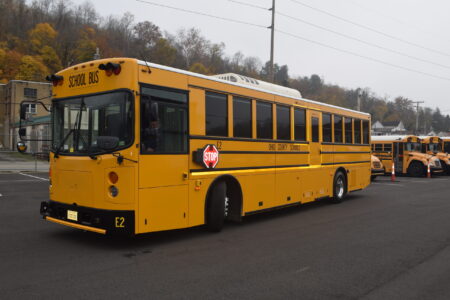
Ohio County Schools participated in November and December in a pilot program to try out "The BEAST," which stands for Battery Electric Assisted Student Transportation. Clay, Grant and Monongalia counties also took part in GreenPower's pilot program.
The bus was brought to Ohio County by trailer in early November, and returned to its home in South Charleston in late December just before the Christmas break the same way.
It can travel about 130 miles on its own with a full charge - or only about 80 miles if heating or air conditioning is used.
Mark Nestlen, vice president for development and strategy for GreenPower, is set to come to Wheeling on Jan. 18 to discuss the bus with bus drivers, mechanics and others in Ohio County Schools, said David Crumm, director of operations for Ohio County Schools.
"There will be a roundtable with the drivers who drove the bus, and we will talk about the pluses we saw," he explained. "We will talk about the things the drivers think could use some tweaking.
"Overall, I think it went well. It is definitely something we would have to use strategically for Ohio County School. But I think there's a lot of promise in the future, also."
Drivers and mechanics alike say the bus has more than enough power to make it up the steep hills in Ohio County.
But the bus is wider than the standard school bus, which makes it difficult for it to travel more narrow roadways, Crumm added.
There is also the issue of heating and air conditioning. When these are use, it greatly shortens how far the bus can be driven on a full charge.
"They will also have to figure out a way to get more heat to the drivers for the inside windows and such," Crumm continued. "There's fogging and stuff like that."
He was asked whether the electric bus holds value to the area.
"That is open to interpretation depending on what your area is like," Crumm said. "There will be areas where they will be useful, and there will be spots that are more challenging - via the length of the route, and temperatures may play a role, also.
"If we got any for Ohio County Schools, we would just have to use them strategically," he said. "It will go up hills and stuff. We would have to use it on wider roads."
The bus is also heavier than the normal school bus, Crumm added. With a full load, it weighs about 42,000 pounds.
"There are some of our smaller bridges that it wouldn't be able to go over," he continued. "More so, looking at the lengths and distances of the routes themselves, some them would put it at the brink of using all the battery depending on the time of year."
Also, the same bus often is called upon to do one bus route for the high school students, then another for the younger ones. After this, there may be a need to take them during the school day on a field trip or transport them to an extra-curricular activity.
There would be no time to recharge the bus between these needs, according to Crumm.
"Those are things you all have to take into account when you look at whether they are a good fit for the county or not," he said.
While it doesn't require gasoline and there is no fuel cost for "The BEAST," its upfront pricetag is considerable. The cost of the BEAST is about $375,000, compared to $130,000 for a standard gasoline-powered bus.