Economic development experts call for resources for site selection, broadband, and entrepreneurship
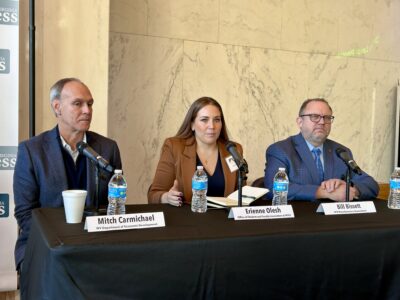
Photo by Steven Allen Adams Mitch Carmichael, cabinet secretary of the Department of Economic Development; Erienne Olesh, executive director of the Office of Student and Facility Innovation at West Virginia University; and Bill Bissett, president of the West Virginia Manufacturers Association, speak to reporters Friday during the West Virginia Press Association’s Legislative Lookahead.
CHARLESTON – West Virginia has been booming with major economic development announcements over the last several years, but a panel said Friday that the state cannot slow down making improvements to infrastructure and how it assists businesses and start-ups.
Attendees of the West Virginia Press Association’s annual Legislative Lookahead Friday heard from a panel of economic development experts: Mitch Carmichael, cabinet secretary of the Department of Economic Development; Erienne Olesh, executive director of the Office of Student and Facility Innovation at West Virginia University; and Bill Bissett, president of the West Virginia Manufacturers Association.
The panel praised recent economic development announcements, such as Nucor Steel in Mason County, Form Energy in Weirton, Berkshire Hathaway in Jackson County, and Wednesday’s announcement by LG that it would launch its NOVA North American Innovation Center project in West Virginia.
“West Virginia has the best value package to take to the nation and the world, as you saw earlier this week, to attract world class companies to our state and to energize the economy and the development and the initiatives that are ongoing in our state,” Carmichael said.
Carmichael, other state economic development officials, legislative leadership, and the heads of the state’s major public universities have been traveling the nation as part of the Choose West Virginia campaign. The group has met with large manufacturers and Fortune 500 companies, including LG officials last summer. Speaking earlier Friday, state Senate President Craig Blair and House Speaker Roger Hanshaw said the initiative was clearly a success.
“The fact of the matter is that we’re going out throughout the country, the world, and getting our message out about how great the State of West Virginia is. And it’s working, ladies and gentlemen,” said Blair, R-Berkeley.
“It represents perhaps the greatest collaborative effort that I’ve ever been involved in in my lifetime,” said Hanshaw, R-Clay. “It’s beginning to bear fruit. It’s beginning to show us the kind of returns that we all said it would show.”
But it’s not just the recruitment of large businesses; it’s also the work being done to help small businesses, start-ups, and entrepreneurs that Olesh said was key. According to Olesh, 98% of the businesses in West Virginia are small or new start-ups, with 50% of the state’s workforce employed by this sector.
The state passed legislation a few years ago for a matching fund program to provide competitive federal grants to new companies in the tech sector. West Virginia Entrepreneurship Ecosystem, led by Amber Ravenscroft and Tara St. Clair, helps connect new businesses and start-ups to state and federal resources through wvbusinesslink.com. But Olesh said start-ups in West Virginia lack access to investment funds.
“We need to continue making sure that we are investing in our small businesses, in our start-up companies,” Olesh said. “West Virginia is still a venture capital desert. And so, for states like ours, it’s important that we have a way of continuing to empower those small businesses.”
Olesh said that with LG investing more than $700 million to create regional hubs and partnering with Marshall University in Huntington and West Virginia University in Morgantown to work with local companies, entrepreneurs, and business start-ups to bring technological advancements, that could create a snowball effect of other investors willing to bet on West Virginia companies.
“Getting that first person to believe in you to invest in your company will be the hardest dollar that your company has to work for. I think that that is a good analogy to what we’re seeing with LG,” Olesh said. “I think that the great work that the state did in really being able to catalyze and memorialize LG coming here, I think that is the big start to hopefully what I think is going to be a windfall of other investors.”
Bissett said West Virginia needs to do more when it comes to preparing potential sites for major manufacturing. A former president of the Huntington Regional Chamber of Commerce, Bissett said neighboring Kentucky and Ohio have better site selection programs that often make it harder for West Virginia to compete for new sites.
“We were getting killed on site prep in Kentucky and Ohio,” Bissett said. “We’d have this check mark box of what we offer, what they offer – what Ohio and Kentucky offer – but we don’t have the flat land. We don’t have the archeological study done. We don’t have the water and sewer process; all the things you have to have to say, ‘you can move in.’ It is an investment – again, a risk – but the reward is tremendous.”
“We’re competing against other states that have perhaps site-ready places for which the businesses can come and locate businesses,” Carmichael agreed. “Many other states have site preparation programs and entities that create the landscape, flatten the area, provide water, sewer, broadband, roads, infrastructure components, even to the point of doing spec buildings and so forth.”
Carmichael also said broadband expansion is key. The state has available nearly $2 billion in federal funding through multiple sources for broadband expansion, along with the detailed maps showing unserved and underserved portions of the state. The Department of Economic Development has multiple programs, grants, and loans, with several broadband projects ongoing.
“West Virginia – under this administration – has obtained more funding from the federal government programs, the highest per capita funding in America for the expansion of broadband,” Carmichael said. “That in itself will also drive incredible economic growth for our state.”
Lawmakers and economic development officials all agreed Friday that more needs to be done to incentivize childcare in West Virginia in order to bring more people into the workforce and in turn create more small businesses – daycare centers.
“As a mom, I certainly have felt the struggle of finding childcare myself,” Olesh said. “You have to remember most childcare in the state, those are small businesses. Those are start-up companies. We can kind of lift all boats here … whatever we can do to help support small businesses and start-up companies should also, in turn, help support those childcare efforts so we can create more of them and make it a more robust system.”
“The number one thing is childcare,” said House Minority Leader Sean Hornbuckle, D-Cabell. “We’ve got to make sure the people have the ability to go get these great jobs. Can they pay for it? Can they keep their children there?”
Senate Bill 656, passed in 2022, provides the credit for employers who provide child care facilities to employees, covering the costs of capital investments and operating costs at 50% of the employer’s capital investment at a rate of 20% each year over a five-year period and 50% of the operating costs. Hanshaw said the House is considering expanding this childcare tax credit to smaller businesses.
“We have a pretty clear line of sight on expanding that opportunity to our smaller employers in West Virginia as well,” Hanshaw said. “We’d like to see it made available to another smaller subset of West Virginia employers.”
Top Headlines
Ohio County School Board Approves $87.8 Million Budget
Risk-Sharing Promotions at Theater, Arena Often Lead to Losses
WHEELING – The concert industry as a whole has been facing the realities of a tough economic environment for ...
New Greenbrier lending agreement questioned by current lender seeking court-appointed receivership
Man Killed In Officer-Involved Shooting Identified
Cameron Man Arrested On Attempted Murder, Child Abuse Charges