
Flanigan Brings Supreme Court Campaign Back To Wheeling
Trending
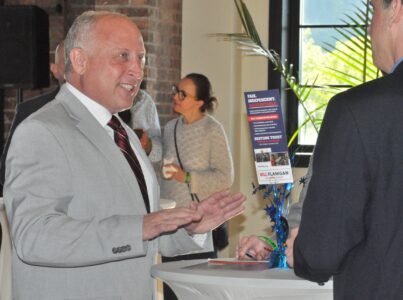
WHEELING -- West Virginia House of Delegates member Bill Flanigan, R-Ohio, returned to the Northern Panhandle this week for a campaign meet-and-greet in Wheeling as he continues his run for a seat on the West Virginia Supreme Court of Appeals.
Flanigan, who is seeking the Division 2 seat, has spent recent weeks traveling across the state, with plans to visit all 55 counties as part of a grassroots effort to connect directly with voters ahead of the 2026 election cycle.
At the center of his campaign, Flanigan said, is a deep respect for the law and the role of the courts in upholding it.
"For me, having been in the legislation twice, having been a representative of Monongalia County and currently representing Ohio County, one of the things I have noticed, more prevalently now, a lot of legislation is presented that is not constitutional," he said during his campaign event at Waterfront Hall on Monday. "That's a big issue for me. If it’s not constitutional, I wouldn't vote for the bill. I would try to amend it and if they refused to amend it, I would not vote for it. Whether I like the bill or not, it at least has to meet certain standards."
He said that belief helped shape his decision to seek a judicial seat.
"I've been all over the state and I am just trying to shake hands and meet as many people as I can, and that's what tonight is about," Flanigan said. "But getting out and just traveling through and visiting all parts of the state, I have met so many West Virginians from so many walks of life. Even at gas stations, when we pull in with the truck and someone will ask 'who's Bill Flanigan?' and I will say 'I am' and then we will have a conversation."
A longtime attorney and former delegate from Morgantown, Flanigan was first appointed to the West Virginia House of Delegates in 2016 to represent District 51. His service was cut short after a cancer diagnosis, leading him to step away after one year in office. He later returned to public life following recovery.
Flanigan moved to Wheeling in 2021, citing family needs, and was re-elected to the House in 2024 representing District 4. He has remained active in the community through public appearances and local radio while continuing his legal practice.
Born in Clarksburg and raised in Salem, Flanigan holds degrees from Salem-Teikyo University, the University of San Francisco and the West Virginia University College of Law. He is a member of the West Virginia Bar.
Throughout his statewide tour, Flanigan said voters are consistently raising concerns about fairness and transparency in government.
"One of the things I am hearing throughout the state whether it’s Monroe County or Wayne County, people want to have better access to the courts, they want to know that it is fair and they want to know who they elect to that position and not appointees," he said.
He also pointed to broader concerns he says he has heard from residents.
"A lot of issues I hear about are the things we can't really talk about on the judicial level because we are limited, but people often ask me about the data centers, water issues and having access to water in the lower part of the state," Flanigan said. "There's been a big uprising recently with incumbents that are being challenged and endorsed by the governor. That's really been a hot topic."
Flanigan said his decision to enter the race for the state's high court was rooted in his experience in the Legislature.
"A lot of legislators would simply say 'it's constitutional until a judge says otherwise' and our executive branch literally said on some of my no votes, they would be pressing forward and good luck having it challenged in the courts," Flanigan said. "So I said, 'OK fine, maybe I should go sit on the court then.' I'll switch branches and let me go over there and I can make that decision."
The winner of the Division 2 race will complete the term of Justice Elizabeth "Beth" Walker, who retired last year. Gov. Patrick Morrisey appointed former circuit judge Thomas H. Ewing to serve on an interim basis. Ewing and Flanigan will face off in the election to determine who serves the remainder of the term through 2028.
Flanigan's candidacy comes amid a long gap in Northern Panhandle representation in statewide office. Few officials from Ohio, Brooke, Hancock or Marshall counties have held statewide posts in recent decades. One of the last was former state Treasurer Andrew "Andy" Maston in the 1980s.
Historically, the region has also seen limited representation on the West Virginia Supreme Court of Appeals. Only four justices have come from Ohio County, along with one each from Hancock and Marshall counties. The most recent was Arthur M. Recht of Wheeling, who served on the court from 1995 to 1996.
Flanigan said he welcomes support from across the political spectrum as he campaigns statewide.
"I would love to have your support," he said. "My race is for a two-year term. There's only two years left on Beth Walker's seat, and in two years, I will have to run again. If they don't like what I do over those two years, they have a chance to put me right back out."
He also noted the backing he has received from a broad coalition of supporters.
Flanigan, a Republican, has been endorsed by supporters across political lines, including attorney Teresa Toriseva, libertarian gubernatorial candidate Erika Kolenich and various business and industry leaders as well as labor groups, according to his campaign.
Flanigan said his decision to seek a seat on the state's highest court was also influenced in part by what he has observed in recent election cycles and what he believes the judicial system should represent. He said voters deserve more engagement and accountability in judicial races, especially at the statewide level where outcomes can shape law and policy for years.
"I watched the last election cycle. We had two Supreme Court Justices go through unopposed and for a state election like that, for me, it was quite surprising," he said.
Flanigan said that concern connects directly to his broader judicial philosophy, which he described as rooted in consistency and constitutional application rather than political interpretation. As he continues his statewide campaign, he said that principle remains central to his message to voters.
"My hope is that, if elected, there will be enough people on the West Virginia Supreme Court that will agree that the constitution should be applied as it’s written,' he said. "It shouldn't be about political influence."
Flanigan added that not only is law not subjective or up for interpretation, it has to be applied consistently.