
Former U.S. Congressman David McKinley Dies At Age 79
Trending
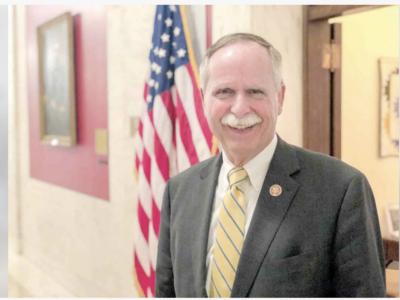
David Bennett McKinley, P.E., a seventh-generation West Virginian who devoted his life to his state as an engineer, a builder, a legislator, and a United States Congressman, died peacefully at his beloved family home, Willow Glen, in Wheeling, West Virginia. He was 79.
Born in Wheeling on March 28, 1947, David McKinley came of age with the conviction that West Virginia's best days lay ahead, and he spent more than three decades in public life doing everything in his power to make that vision a reality.
He graduated from Purdue University in 1970 with a degree in civil engineering, a credential he carried with quiet pride throughout his public career, signing his name "David B. McKinley, P.E." long after most men would have set the title aside. He was among only a handful of licensed professional engineers ever to serve in the United States Congress, and he never forgot what that meant: problems had solutions, plans required sound foundations, and the work of building something lasting demanded both vision and discipline.
After more than a decade as a civil engineer, McKinley founded McKinley Architecture and Engineering in Wheeling in 1981, a firm that grew to become one of the region's most respected practices, involved in nearly $3 billion in construction value. Among its most cherished projects was the restoration of Wheeling's historic Independence Hall, a fitting symbol of McKinley's belief that West Virginia's communities were worth investing in, worth preserving, and worth fighting for.
In 1980, David McKinley entered the West Virginia House of Delegates, representing the 3rd District. He would serve for fourteen years. It was a time when Republicans were a decided minority in Charleston. At times, fewer than 10 Republicans served among 100 delegates, and McKinley fought for conservative principles not because it was politically expedient, but because he believed in them.
He championed limited government, fiscal responsibility, the rights of working West Virginians, and the dignity of the coal industry that powered his state. He served as chairman of the West Virginia Republican Party from 1990 to 1994, helping to lay the foundation for a political realignment that, in the decades that followed, transformed West Virginia into one of the most reliably Republican states in the nation. He did not live to take credit for it. He did not need to.
In 2010, after an unsuccessful bid for governor in 1996, David McKinley ran for Congress and won, defeating the Democratic nominee by fewer than 1,500 votes to become the first Republican to hold West Virginia's 1st Congressional District seat in 42 years. He would go on to win five more times, never receiving less than 62 percent of the vote in a general election.
His mission, from his first day in office to his last, was singular: to help the citizens of West Virginia achieve the highest quality of life. He pursued it with the methodical determination of the engineer he always was. During his twelve years in Congress, 29 bills on which McKinley served as lead sponsor were signed into law, 49 McKinley-led bills passed the House, and he successfully offered 103 amendments to other legislation.
He served on the House Energy and Commerce Committee, where he fought tirelessly for West Virginia's energy workers and pushed back against what many called the war on coal. He was an early and persistent advocate for domestic energy production, rural infrastructure, and the kind of practical, results-oriented legislating that prioritized West Virginians over Washington politics.
"My allegiance during my 12 years in Congress was to my state," he said near the end of his service.
That independence defined him. He was ranked among the most bipartisan members of the United States House of Representatives and the most bipartisan member from West Virginia at a time when bipartisanship had become almost an act of political courage. He voted for the Infrastructure Investment and Jobs Act, the CHIPS and Science Act, and the creation of the January 6th Commission, each time following his conscience rather than the crowd. It cost him his seat in the 2022 primary. He bore that with grace.
David McKinley is survived by his wife of 45 years, Mary Gerkin McKinley, a critical care nurse and master's-prepared clinician whose dedication to caring for others matched his own; his four children, David H. McKinley, Elizabeth (James) Boyle, Amy McKinley, and Bennett (Katy) McKinley; and his grandchildren, Jackson M. Boyle, David J. McKinley, Thomas H. Boyle, Maxwell B. McKinley, Anne M. McKinley, and Louis B. McKinley, who knew and loved him as PaPa.
He is also survived by a state that is better for his having served it -- with more jobs, more infrastructure, and more roads, bridges, hospitals, and schools than it had when he first took his oath of office. He is survived by the engineers, architects, and builders whose profession he elevated in the halls of Congress. He is survived by the Republicans who hold supermajorities in Charleston today, on foundations he helped lay when it was lonely, thankless work to do so.
David McKinley spent his final days at Willow Glen, the house that represents his family's legacy, in the city that shaped him, in the state he never stopped serving. West Virginia has lost one of its finest sons.
Funeral arrangements are pending. The family asks that in lieu of flowers, contributions be made to the David B. McKinley scholarship fund at West Virginia University’s Statler School of Engineering.