Collector Extols Virtue of Wheeling Pottery Ware
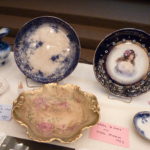
Photo by Linda Comins Wheeling Pottery pieces from Donna Schrader Freter’s collection include, above, a bride’s bowl dated 1907, center; a “Dewey Day” cup and saucer, at left, with Flow Blue examples and a portrait plate in the background.
With a personal collection numbering 600 to 700 pieces, Donna Schrader Freter shared her love of Wheeling Pottery Co. wares with a large audience at the Ohio County Public Library last month.
Freter, who spoke at Lunch With Books, displayed several pieces from her collection and showed photographs of other Wheeling Pottery items that she has acquired in 40 years of collecting the company’s ware. She is writing a book about Wheeling Pottery.
The daughter and granddaughter of South Wheeling natives, she lived there for 10 years before moving to the city’s Elm Grove section. Freter, a former teacher and retired social worker, has been an antiques dealer for 35 years.
She said that four wealthy young men — George K. Wheat, Charles W. Franzheim, W.A. Isett and E.M. Pearson — invested in the Wheeling Pottery Co., which was formed in 1879. The firm remained in business until 1908.
During Wheeling Pottery’s years of operation, its style and volume of production were unsurpassed by any other American companies, Freter said.
Wheat, who conceived the idea of opening a pottery, bought property that had been used for his family’s tannery. Two buildings were erected for the new business: the La Belle plant at 31st and Wood streets and the adjacent South Wheeling plant at 31st and Chapline streets. “It was a huge area in South Wheeling,” she said.
The company employed 1,200 people, she said, adding that the La Belle decorating department employed more workers than any other company making china in the United States.
At its peak, the firm owned four plants, including the Riverside plant in North Wheeling and a plant in Tiltonsville. The home office was in Wheeling, with a showroom in New York City. Its sales territory covered most of the eastern United States, she said.
Salesmen took sample products to show prospective buyers, while catalogs were produced to sell the ware to wholesalers that supplied merchandise to retailers, she said. In addition, representatives from “wholesale and retail firms came to Wheeling to see what Wheeling Pottery was producing,” Freter said.
In its last 10 years of production, Wheeling Pottery bought the Riverside plant from Ohio Valley China Co. This plant was located at the site of the present-day North Wheeling Dream Center (the former Bond Bakery and West Virginia Department of Health and Human Resources building), she said.
The firm also purchased the Avon Faience Co. in Tiltonsville. Frederick H. Rhead, a manager for Avon Faience, moved to East Liverpool and later designed Fiesta ware for Homer Laughlin China Co., she said.
Wheeling Pottery’s most famous creation was the Dewey jardiniere (a large flowerpot) and pedestal set. Freter related that in 1899, some prominent businessmen approached Franzheim, who was then president of the firm as well as one of its designers, and wanted a wedding present for Admiral George Dewey and his second wife. Franzheim showed them his design for a special Christmas gift for his own wife, and they liked it. The special jardiniere was inscribed “From the city of Wheeling to Admiral and Mrs. Dewey” and dated Nov. 23, 1899, she said.
Freter showed photos of the Dewey jardiniere from the Naval Museum in Annapolis, Md. She said Oglebay Institute’s Mansion Museum owns two copies of the famous jardiniere, one in Flow Blue and one with a different combination of colors.
Wheeling Pottery also made a special vase to thank William McKinley for sponsoring a tariff bill, but the president was assassinated before he could receive the gift, she said.
She owns a Flow Blue plate that was part of a set of china made for the Navy gunboat Wheeling, that saw action in the Spanish-American War. The company gave a complete dinner service to the captain and to the crew of the gunship. “The serving pieces had scenes from Wheeling on them,” she said.
Freter showed a “very well-made” Wheeling Pottery tray produced for the USS Indiana and a “Remember the Maine” pitcher with pictures of the ship and its captain.
She said that “the Tiltonsville plant made very special items,” such as college boys’ mugs and pitchers that depicted football players in Ivy League jerseys. She showed one of the rare mugs, emblazoned with a figure wearing a “Y” jersey for Yale University.
Both functional lines (dinnerware, tea sets, serving sets and chamber sets) and decorative pieces (such as vases, plaques and portrait plates) were produced by Wheeling Pottery. A set of the Blue Diamond china pattern, made in the distinctive Flow Blue style, sold for under $25, while a copy of its Dewey jardiniere set cost $75 in 1900. “Not too many people could afford it,” she commented, adding that a Wheeling Pottery worker’s annual salary was $150.
The firm created custom-made pieces for individual customers and commercial clients, as well as commemorative plates for fraternal organizations.
“They also made little dishes like this that companies would give away to their customers,” Freter said, showing a small plate made for Palace Furniture of Wheeling in 1897 and a saucer given to customers of the Joseph Speidel Grocery Co. of Wheeling for a “Dewey Day” observance in 1900.
Household items included turkey sets, featuring a big platter with a picture of a male turkey and eight to 12 other plates depicting turkey hens and chicks, she said. In addition, the firm produced a large game platter and 12 smaller plates depicting game birds and animals.
Wheeling Pottery also made children’s sets with a tiny cup and plate or a small sugar bowl and creamer, berry sets with a master serving dish and smaller individual dishes, chocolate pots, tea and coffee sets, water pitchers, syrup pitchers, cracker jars, tureens, pedestal cake plates, trivets, umbrella stands, calling card plates, pen trays and dresser trays.
Sales of the firm’s Victorian ware dropped after the death of Queen Victoria. Tracing Wheeling Pottery’s decline and eventual closure, she said the company “didn’t want to make more utilitarian goods,” while “the working-class population of Wheeling couldn’t afford to buy this fancy ware.”
Features
National Day of Prayer Events Set at Capitol Ballroom
WHEELING – Jon and Jolene Hamill of Lamplighter Ministries will be the guest speakers at the local National Day ...
Library Program to Welcome Author Julia Flint
WHEELING – The Ohio County Public Library's next Lunch With Books program will feature author Julia Flint and a ...

Wheeling Fashion Week Announces 2026 Runway Show Lineup
Friends of Wheeling Celebrates Historic Preservation Month

Music and Recognition at Thursday Music Club