
Friends of Wheeling Celebrates Historic Preservation Month
Trending
(Editor's Note: This is the first in a series of articles in May to highlight historic preservation efforts in Wheeling as part of celebrating Historic Preservation Month.)
WHEELING - May is Historic Preservation Month - a time when there is increased emphasis on historic structures and efforts to recognize their value and work to preserve them. The local, non-profit, historic preservation organization, Friends of Wheeling, has been involved in these efforts since its founding in 1970, making it the oldest such organization in the state.
Original members of Friends of Wheeling included such names as Betty Woods "Snookie" Nutting, Beverly Fluty, Mary Ann Hess and Hester Byrum, among many, many more. Over the years, this entirely volunteer group was involved in restoration of West Virginia Independence Hall and renovation work on the Wheeling Suspension Bridge. It has also provided numerous house tours, periodic cemetery tours, training workshops on building trades and deed research, and renovation of more than a dozen individual structures. It also maintains the historic Robert W. Hazlett House, located at 921 Main St. in Wheeling.
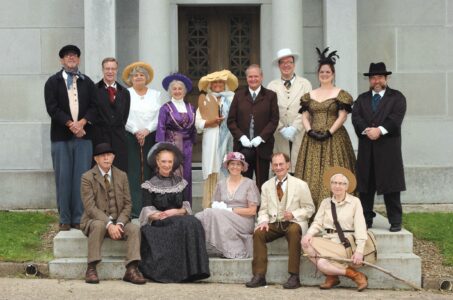
The group typically features a cemetery tour every other year, with the most recent tour at Mt. Wood Cemetery in 2025. Other tours have been at Stone Church and Greenwood cemeteries, where costumed characters have portrayed famous and infamous people from Wheeling's past. These free tours are ways of engaging visitors of all ages with local history as seen through the lives of capitalists, suffragists, journalists, gangsters, soldiers, politicians and more.
The latest renovation project undertaken by Friends of Wheeling is the Hughes Duplex, located at 722-724 Main St. in North Wheeling. This antebellum structure was originally owned by Thomas Hughes Sr., a gunsmith by trade, long-term member of Wheeling City Council and the Wheeling & Belmont Bridge Co. Board (the group that had the Suspension Bridge built), Wheeling treasurer, and the father of several children who were ardent Confederate supporters during the Civil War.
Son Thomas Hughes Jr., was a very successful tailor; daughter Dr. Eliza Hughes was the first college-educated female physician in what is now West Virginia; and son Dr. Alfred Hughes was a successful homeopathic physician who refused to sign the Oath of Allegiance to the Union during the Civil War and spent some seven months under arrest in the Union prison camp, Camp Chase, in Columbus, Ohio.
During Alfred's incarceration, his wife Mary and five children remained in Wheeling. Alfred and Mary kept up a nearly daily written correspondence, and copies of more than 100 of their letters have been found and are being transcribed. After his release, the family moved to Richmond, Virginia, where Alfred served in the Virginia legislature and was a doctor to Mrs. Robert E. Lee.
When the poor condition of the Hughes Duplex was discovered several years ago, the Wheeling National Heritage Area Corp. stepped in and had structural work done on the rear, along with a roof replacement. The city of Wheeling also helped by donating funds that would have been used for demolition. The North Wheeling neighborhood organization -- Victorian Old Town Association -- also held a fundraising house tour to help with the cost of renovation work.
These efforts undoubtedly saved the structure from loss. It was then sold to a private developer that completely gutted the entire interior, including the second floor flooring. When the cost of continued work seemed impossible for the private owner, it was donated to Friends of Wheeling in early 2022.
Saving the building was deemed to be important because of its unique history and also because its loss would have left an unsightly hole in an otherwise intact row of historic properties.
Extensive work has been carried out by Friends of Wheeling and has included the installation of underground utilities, restoration of the historic windows and rebuilding the masonry wall at the rear of the south half of the structure.
Current work includes restoration of woodwork and brackets along the roofline on the front facade. Future work will include demolition of a failing addition on the rear of the north half of the duplex, followed by rebuilding of the rear wall there. Finishing work on the interior would follow -- or the group might sell it to another developer that would finish the building as two residential units or a combination of residential and commercial uses.
The original first floor flooring was wood that was built over wooden beams that had direct contact with dirt -- with no basement or even a crawl space. That floor had to be removed and has been replaced with concrete. During the removal process, an earlier foundation was found under 724 Main St. Research into deed records and descriptions of early Wheeling showed that a two-story brick structure was at that location as early as 1815, housing a grocery owned by Thomas Johnston, with the former home of Noah Linsly, who had died in 1814, just to the south of the adjacent alley. Descendants of the Johnston family have been located and have supported the project. Other financial support has been provided by descendants of the Hughes family.
Grant funds from the West Virginia State Historic Preservation Office have been essential, along with support from the Bruhn Historic Preservation Fund through both Wheeling Heritage and Preservation Alliance of West Virginia, and facade grants from the city of Wheeling. Most importantly, financial support has been received from several local foundations and many individuals.
Another important component of the work has been the demonstration of techniques that are appropriate for use on historic structures. Removal of lead paint on the exterior, for example, was done using a method that peeled away the paint and encapsulated it to prevent environmental damage. Brick repointing was done using mortar that doesn't damage the soft bricks that were common in the mid-1800s. And window and wood trim restoration was done appropriately.
Wheeling is fortunate indeed to have contractors and artisans who are skilled and knowledgeable in working on historic structures.
And, of course, Friends of Wheeling is fortunate to have understanding and guidance from the state and the city and financial support from those who recognize the importance of Wheeling's architectural heritage.
More information on Friends of Wheeling can be found at: https://wheelingheritage.org/friends-of-wheeling/.
Jeanne Finstein is a Wheeling resident and president of the Friends of Wheeling.