
Opportunities Eyed for Former W.H. Sammis Plant Site in Stratton
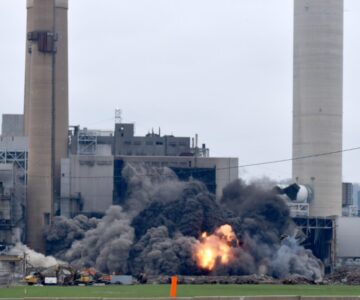 Stephanie Elverd (file)
 Trending
The current owners of the old Sammis plant property are hoping to bring a data center to Jefferson County -- but to make it happen, they need a declaration that it is one of Ohio's priority investment areas.
House Bill 15, which takes effect in mid-August, authorizes local governments -- in this case, the Jefferson County commissioners -- to pass resolutions asking the Ohio Director of Development to designate sites in their jurisdictions as priority investment areas. That designation brings with it accelerated permit reviews, brownfield funding for site preparation and development costs plus a utility tax exemption.
Brownfield sites and former coal mines are eligible for the designation.
The Sammis site, acquired by Houston-based Energy Transition and Environmental Management in 2023, is in the demolition and remediation stage, with the structure above state Route 7 in Stratton slated to go in the first quarter 2026.
"We've knocked down most of the buildings, and we expect to finish that project in the first quarter of 2027," Dan McDevitt, co-founder and general counsel, told the Jefferson County commissioners Wednesday. "We're now starting to think about what happens next at that site."
Initially, McDevitt said they figured "some kind of industrial development," perhaps a multi-modal transportation, would be a good site fit, "but the world has changed. What didn't exist a year ago are these massive data centers ... think of them as server farms, thousands and thousands of computers running artificial intelligence algorithms or serving cloud storage functions."
McDevitt said the property has an on-site switching station and substation, so power can be imported or exported." There's water and rail access as well as a large loading and unloading area.
"These data centers need power -- we're talking about a very significant amount of power, 500 megawatts of power, that these (centers) consume," he said. "We're not data center developers -- our business is buying these difficult properties, we take on all the risks and responsibilities (to clean them up) and then we find someone else to do the forecast. When it's finished, it looks like right now it (would work for) some sort of a data center development project. And the way they typically work these things is, we would sell it to a developer, they would build out the campus and then they lease it, lease the services from the server farms, to like a Google or an Amazon or something like that."
McDevitt told commissioners if it happens that way it would be "a significant investment. You're looking at billions of dollars in investment, jobs during construction ... I think we tossed out a number of, say, 1,000 jobs while the thing's being built, there'd be a couple, three years of construction time then maybe a couple hundred permanent jobs, (with) follow on employment that comes from that."
McDevitt figures that priority investment designation is critical, saying HB 15 "is basically a reworking of Ohio's energy policy. The bill was built around the theory of trying to encourage the redevelopment of power in the state."
"There's a very specific tax benefit. It's not a property tax on a real estate tax payment, but it's a relief from what we call the 'utility' tax and a particular part of it -- the part of the tax that's relevant here is building out the infrastructure to either deliver power or natural gas to the site. And one of our plans at this site is to build a natural gas pipeline to come into the site, bring fuel, CCGT (combined cycle gas turbine) or other gas-fired generation, to either sell into the grid, to resell just as a power play or else to power up the data centers. They need power, they're power hogs."
McDevitt said the priority investment area designation "will make this site incrementally more attractive than a site that (doesn't have it)."
"I think it's a good thing for the county -- we're optimistic about securing a data center development here at the site," McDevitt said.
Commissioners say they're intrigued, but said they need to "run it by the prosecutor's office" first.
"(But) our board will do anything possible to bring in new opportunities to our county," Commissioner Tony Morelli said. "HB 15 gives renewable energy companies tax relief if the property was used for specific industry, brownfields, abandoned coal or energy companies. The Sammis plant checks the boxes. ETEM is asking us to go through the process which (involves) commissioners designating it as a priority investment area. Once that is completed the site would be marketed for energy development (so they can) use the specific tools the bill was written for."
Morelli said AI -- artificial intelligence -- "is one business that needs extreme amounts of energy."
"Designating this property (as a priority investment area) will open up opportunities to be in the game, right here in our county," Morelli said.
Commissioner Jake Kleineke said the Sammis site "probably would be a good place for an alternative power source, I think it would be a great opportunity to spark interest in other technology companies to come to our region.
"I see it as a great opportunity for the county to grow," he said. "I just think it's a good opportunity for the county to experience some growth versus it just sitting stagnant, growing grass."
He said similar developments have brought "gigantic growth" already along the Interstate 270 corridor in Franklin County.
"It's created a lot of opportunity, jobs for people who would like to relocate here," he said. "And there's construction benefits as well -- we still have vibrant trades here ... electrical unions, pipefitters, carpenters, etc., that could benefit from this type of growth."
Kleineke said they have to be forward-thinking.
"I don't see a downside to it, honestly," Kleineke said. "We're not going to bring coal-fired plants back, we've got to do something with that property. I would like to see something more diverse than a server farm. I'd like to see alternative-fueled power generation. Those server farms take up a lot of power to run, but they'll also put a strain locally on our power grid. These things are happening all over the state of Ohio and consuming more power than we're making. With the abundance of gas we have here, I would love to see a gas-fired power plant there, and maybe in addition to the dam that's already there ... hydroelectric power generation."