
Northern Panhandle Home to Most Dams Deemed High-Risk
Officials Say No Cause Concern
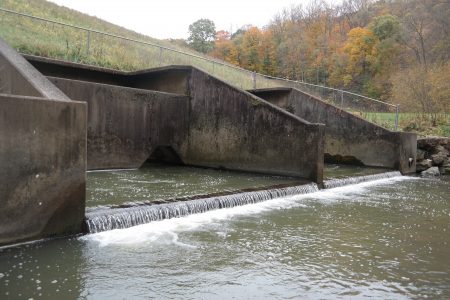
Photo by Alex Meyer Water flows through the Wheeling Creek Dam No. 7, one of 43 high hazard potential dams in the Northern Panhandle, near Middle Wheeling Creek Lake.
WHEELING — While many dams in the Northern Panhandle have a high hazard potential and are considered at-risk, that’s not necessarily a reason for concern, said Brian Farkas, executive director of the West Virginia Conservation Agency.
Of the 43 dams in the region’s six counties, 35 are labeled high hazard potential and six others are considered significant hazard potential, according to the National Inventory of Dams.
That hazard potential, though, is based on population levels near the dams rather than their structural integrity, Farkas said.
Despite that, work needs to be done to improve the condition of dams in the state, he said.
At a meeting of the Joint Legislative Committee on Flooding held in Charleston last week, Farkas spoke to lawmakers about at-risk dams in West Virginia.
Eight out of the top 10 at-risk small watershed dams in the state are located in the Northern Panhandle, according to the National Resources Conservation Service.
“The dams are at risk in terms of ranking based on population,” Farks said. “They protect the most people. It’s not because they’re on the verge of failure.”
Of the top 10 at-risk dams, most are in the Wheeling Creek watershed in Ohio and Marshall counties and the Harmon Creek watershed in Brooke and Hancock counties, Farkas said.
The Wheeling Creek No. 7 dam near Triadelphia tops the list with 6,128 at risk.
Meanwhile, the “high hazard” label, which is used by regulatory agencies, means that if a dam were to fail, it would cause significant property damage and some injuries, Farkas said.
Marshall County is home to the most dams in the region, with 16 high hazard potential dams and two significant hazard potential dams, according to the National Inventory of Dams. Ohio County has seven high hazard dams and Brooke County has eight high hazard dams.
In addition, there are two significant hazard dams and one high hazard dam in Hancock County. Wetzel County has one high hazard dam while Tyler County has two.
The majority of dams in the region are designed for flood control and stormwater management.
“I will tell you that they do provide significant flood prevention and they hold back an awful lot of water,” Farkas said. “When Hurricane Ivan came through (in 2004), they kept an amazing amount of water from entering the creek and flooding Wheeling.”
Statewide, there are 170 high hazard small watershed dams spread out among 25 counties. The dams provide more than $90 million per year in flood protection for 60 percent of West Virginia residents.
At the committee meeting earlier in October, Farkas argued that more money needs to be invested in West Virginia’s dams. More than half of the state’s dams don’t meet current design standards, he said, and it would cost more than $1.7 billion to replace them.
Problems with such dams include seeps, slips and missing or dilapidated toe drains. The dams need regular maintenance and to be brought up to modern standards, Farkas said.
“They’re old and getting older. We have an opportunity to continue their existence and lifespan, but we need to invest in them,” Farkas said at the meeting. “This is a public safety issue.”
Top Headlines
West Virginia Election Day Happens Tuesday
WHEELING – Primary Election Day 2026 happens next week across West Virginia, and Saturday is the last day to cast ...

Buffalo Bill’s House a ‘Silence’ location that’s open for visitors
Sludge Removal at Sewage Plant Stirs Up Intense Stench

Mother-Daughter Duo Brews Success at Table 304

One dead following Thursday night accident in Monroe County
Correction: Marshall County Retired School Employees Meeting Date
MOUNDSVILLE — The meeting date for the Marshall County Retired School Employees was published incorrectly in a ...