
‘It’s Time For Us to Make A Change’
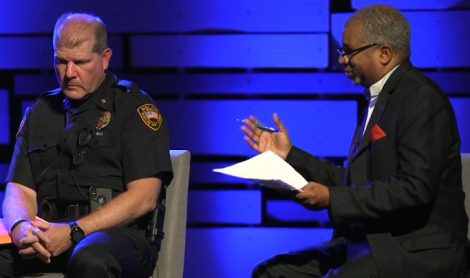
The Rev. Darrell Cummings of Bethlehem Apostolic Temple, right, speaks to Wheeling Police Chief Shawn Schwertfeger during a panel discussion Sunday afternoon at The Vineyard Church in Wheeling.
WHEELING — Religious and civic leaders from Wheeling discussed how to combat racism in society and improve community policing in a candid and at times raw conversation about race relations locally and in the country.
The 90-minute panel discussion at The Vineyard Church in Wheeling was in response to the May 25 death of George Floyd in Minneapolis at the hands of police and the ensuing protests across the nation in its aftermath.
The Rev. Chris Figaretti of The Vineyard and the Rev. Darrell Cummings of Bethlehem Apostolic Temple led the discussion that included other faith leaders and Wheeling Police Chief Shawn Schwertfeger and West Virginia NAACP President Owens Brown.
“At a time like this, we need to talk, we need to lead and we need to stand for what’s right,” Figaretti said to open the discussion that was broadcast on Facebook and over the radio.
Figaretti said he has never seen a single event in his lifetime that has brought together the country as Floyd’s death did two weeks ago.
“George Floyd’s death has bridged the gap that divided us. It’s brought to light that racism is still alive in American, and that’s not OK,” Figaretti said. “The choice is ours, and the moment is now. We do need to build bridges of friendship.”
Schwertfeger said he was honored to be invited to the discussion and hoped he could contribute to the conversation.
“I’m here to listen, but I’m also here to engage in a dialogue. Dialogue is a two-way street,” he said. “I’m here because public trust is paramount to policing.”
Cummings asked Schwertfeger about what positive efforts they’ve seen through the response to protests recently in Wheeling. Schwertfeger responded that some of the protesters knew a few of the officers by name, allowing for both sides to keep the protests peaceful.
“They didn’t just meet those folks. They meet them on a daily basis as they patrol their communities. That enabled them to having a dialogue right then and there,” Schwertfeger said. “I think they trusted us.”
Cummings praised the police for the difficult job they have, but he also asked for others to acknowledge the fear the black community has at times of law enforcement. He pointed to how a simple traffic stop could escalate into something violent.
“Every African American man knows that encounter could cost his life,” Cummings said. “Every African American man knows he has to be careful of what he says, how he moves, how he acts.
“It’s time for us to make a change,” Cummings said.
Cummings said that he understands police officers do not want to be labeled a certain way, but he wants others to understand that black people in America do not want to be labeled either.
“I believe George Floyd’s cry that day on a hot, concrete floor — crying out for his mother that he can’t breathe — is a call … for injustice to take a knee off my neck, racism, to take a knee off my neck,” Cummings said.
“I believe that America will fulfill its promise of being America,” he added.
Schwertfeger pointed out that no one will disagree that racism exists in the Ohio Valley, but he pointed out that police officers “roll their eyes” when they get a 911 call that a black person is simply walking down the street.
“Police officers see right through that,” he said.
But Brown questioned whether there is a need for a citizens review board to oversee the actions by local police departments. Police are the closest to dealing with society, he said, and he would prefer to see some “checks and balances” to offer oversight. Brown added that he thinks the vast majority of police officers are good, but Floyd’s death also revealed the systemic and societal issue of racism.
“I’m not going to deny their humanity,” Brown said. “Sometimes there are bad people out there who do these acts to make it harder for them.”
The Rev. Marcia Allen, who retired from Laughlin Memorial Chapel in Wheeling and lives in Martins Ferry, recounted a recent story about how her two grandsons were accused by a store clerk of stealing items that they had just purchased.
“To be in this skin that we’re in … what I’ve been through, there isn’t any white people who would want to go through what I went through,” she said.
Wheeling Mayor Glenn Elliott spoke only briefly and mostly listened to the dialogue. He said he was “relatively insulated” from race while growing up, but he noticed that black people were treated differently by police when he graduated high school in the early 1990s.
“You have to be very mindful that these issues didn’t just start yesterday,” Elliott said.
He thinks the video of Floyd’s death was a game changer because it was so “real” and so obviously wrong.
“It’s not enough to not be a racist. I have to actively go out and be anti-racist,” Elliott said. “It takes some sort of proactive approach to confront these things.”
Brown said he’s seeing improvement on that front with a lot of white people “coming out in force right now” to protest with the black community.
“We need to recognize that there is more good out there than the racists,” Brown said.
Cummings was pleased with the discussion that he thought was both constructive and informative.
“This is a good start. I wish racism was a light switch we could just turn off, but we can’t,” Cummings said. “Racism isn’t natural. It must be passed on. … Love is more natural than hate.”
He then got up from his high-top seat on the stage and motioned to Schwertfeger, who was sitting next to him a few feet away.
“I would go and hug you,” Cummings said with a laugh, “but the pandemic and all.”
Top Headlines
West Virginia Election Day Happens Tuesday
WHEELING – Primary Election Day 2026 happens next week across West Virginia, and Saturday is the last day to cast ...

Buffalo Bill’s House a ‘Silence’ location that’s open for visitors

Sludge Removal at Sewage Plant Stirs Up Intense Stench

Mother-Daughter Duo Brews Success at Table 304
One dead following Thursday night accident in Monroe County
Correction: Marshall County Retired School Employees Meeting Date
MOUNDSVILLE — The meeting date for the Marshall County Retired School Employees was published incorrectly in a ...