
Trending
WHEELING -- Two women who left an indelible mark on the arts will be among the latest 11 people to be inducted into the Wheeling Hall of Fame.
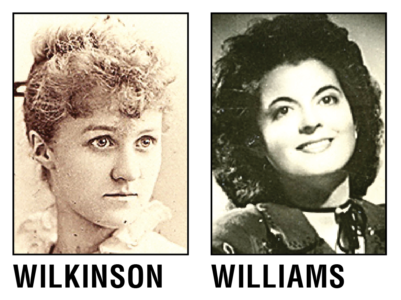
Late artist Edith Wilkinson and late country music singer "Chickie" Williams will be part of the 2023 class, which will be inducted at a Saturday, June 10, ceremony at WesBanco Arena. Wilkinson and Williams are being inducted in the category of music and fine arts.
The event is open to the public and will begin at 6 p.m. A catered dinner is included. Tickets are $40 and can be purchased at WesbancoArena.com, or by calling the box office at 304-233-7000 from 10 a.m. to 2 p.m. Monday through Friday.
Edith Wilkinson
Edith Wilkinson was born on Aug. 23, 1868, to James P. and Lucy Lake Atkinson Wilkinson. Her father had ties during the Civil War to the Union and West Virginia Loyal Volunteers while her mother was an art teacher and artist.
In 1888, at the age of 20, Wilkinson moved from her home in Wheeling to New York City and enrolled in The Arts Student League.
There, she studied with a number of important American painters, including William Merritt Chase and Kenyon Cox. In 1900, Wilkinson enrolled in Teacher's College at Columbia University where she studied with Arthur Wesley Dow, a leading figure in the Arts and Crafts revival.
In 1902, Edith and her partner, Fannie, traveled to Europe where Edith sketched and painted.
In 1905, after earning a degree in Fine Arts, Edith joined Dow's summer art classes in Ipswich, Massachusetts, where she created a series of charcoals influenced by Dow's interest in applying the design principles of Japanese art.
Starting in 1913, Edith became part of the growing art colony in Provincetown, Massachusetts.
For the next 10 years, she spent every summer and fall there, her style switching from the somber palette of her European and New York work to a sundrenched Impressionistic palette inspired by the Provincetown light. During her time there she worked and exchanged ideas with another West Virginian artist, Blanche Lazzell. They both were at the forefront of a group of Provincetown artists who developed what's known as the White Line method of block printing.
Wilkinson's parents died In 1922, leaving her stocks and bonds, to income to support herself. However, a Wheeling attorney who managed the Wilkinson family estate had complete control of the monies released to Edith and only allowed her a modest monthly stipend. Unbeknownst to Edith, he was slowly siphoning off her funds into his own pocket.
In March 1924, Edith was admitted to the Sheppard Pratt Institution, an asylum for the mentally ill in Baltimore, Maryland. Her admittance card describes her as in a "paranoid state." The Wheeling attorney is listed as Correspondent. Released on October 2 that same year, her condition is said to have sufficiently improved.
In February 1925 Edith was readmitted to the Sheppard Pratt Institution, where she would
spend the next 10 years. Her possessions, including her artwork, were packed in trunks and sent back to Wheeling to her only surviving relative, her nephew Edward Vossler. Her last known work is dated July 8, 1925. It's a small unmounted canvas titled "Canoe Place" created from memory of the tidal marshes in Provincetown.
In March 1935 Edith was transferred to Huntington State Hospital in West Virginia by her
nephew, still described as paranoid and now, at age 66, showing early signs of dementia. There she remained until her death on July 19, 1957. She is buried next to her parents in Greenwood Cemetery in Wheeling.
Edith's trunks were finally discovered and unpacked in the 1960s by Edward's sister-in-law,
Polly Anderson, on a visit to Wheeling from California. Her work was displayed in the Anderson
home and inspired her daughter, Jane, to become an artist. Jane brought Edith's work to light in the documentary "Packed in Trunks: The Lost Art of Edith Lake Wilkinson." Edith's work may be viewed in the collections of The Huntington Museum of Art and the Provincetown Art Association and Museum.
"Chickie" Williams
Jessie Wanda Crupe (Smik), known by the stage name Chickie Williams, was born February 13, 1919, in Bethany, to Harriet Ann and John Lester Crupe. In a fan letter she addressed as a teenager to "Buck Williams and the Border Riders" she asked to hire the group to play for a square dance in Hickory, Pennsylvania. When Doc Williams met Jessie Wanda, he nicknamed her "Chickie" because he thought she was a "cute chick." Crupe and Williams soon began a romance.
She married Doc Williams (Wheeling Hall of Fame class of 1984) on October 9, 1939. In 1940, Chickie and Doc moved to Memphis and then moved to Wheeling where they raised their three daughters, Barbara, Madeline, and Karen. The daughters were known on the air as "Peeper," "Pooch," and "Punkin." In 1946, after the birth of their three daughters, Chickie joined her husband's Jamboree radio group, contributing harmony vocals and later upright bass. Chickie greatly valued her family and the girls did travel with their parents in the summer during their tours and sometimes performed with them.
Chickie was an American female country music pioneer best known for performing on the Wheeling Jamboree radio program on Wheeling's WWVA with Doc and their band the Border Riders. In 1947, Chickie's original arrangement of the hymn, "Beyond the Sunset," was charted No. 3 in Billboard trade magazine's Top 100 Country Music Songs. The song was later recorded by Hank Williams and Red Foley. Recording of "Beyond the Sunset" initiated when Chickie, who was fond of blind twin singers from North Wheeling, Maxine and Eileen Newcomer, would visit them. The twins had their own disc cutter which Chickie used to record a poem called "Should You Go First and I Remain" by "Rosey" Rowswell as a gift to Doc on their anniversary. Jean Miller, Doc and Chickie's secretary, heard the poem and suggested Chickie record the classic hymn.
Chickie tended to favor old ballads and hymns which made it difficult to attract existing record labels to take notice of her recordings. So the couple used their own money and her albums were released through Wheeling Records, founded by her husband. Extreme popularity of the recording of "Beyond the Sunset" resulted in selling out of the original record release and was followed by offers from other recording labels to release the song. One record label was later allowed to distribute that recording.
Chickie was known to her fans as "The Girl with the Lullaby Voice." She remained a Jamboree cast member for 52 years, retiring alongside Doc in 1998.
Her contribution to country music included a discography of nine albums, 11 singles and EPs, and three compilations. With Doc, she performed throughout the eastern United States and Canada and were inducted into Jamboree USA's Walkway of Stars. They have been made
honorary citizens in Maine, Vermont, and New Hampshire. In 2008, the state of West Virginia named a section of Interstate 70 in Wheeling the "Doc and Chickie Williams Highway; Country Music Royal Couple." Chickie and Doc were inducted into the West Virginia Music Hall of Fame in 2009.
Chickie Williams died on November 18, 2007, at the age of 88 in Wheeling.
A collection of manuscripts, photographs, and audiovisual items from Chickie's and Doc's collection are maintained at the West Virginia State Archives.