
Marshall County Chamber Welcomes Oil And Gas Leaders For Forum
Trending
Marshall County has long been a leader in West Virginia in natural gas production, so the Marshall County Chamber of Commerce wanted to get leaders within the energy industry together with leaders from the fields of education, government, law enforcement and more to discuss what the county has done for energy and what it can provide for the future.
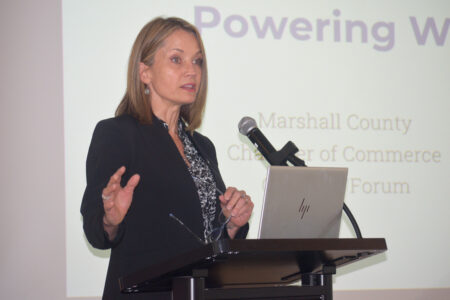
The Marshall County Chamber held its inaugural Oil and Gas Forum on Thursday at Grand Vue Park, where notable members of all those sectors could come together, learn more about each other and learn more about the impact Marshall County makes statewide.
“I think it’s an educational program where people can learn about who the major players are in Marshall County and the Northern Panhandle, where that stands and where we stand,” said Scott Reager, executive director of the Marshall County Chamber. “From a chamber standpoint, we’re looking to develop this out even more as an energy hub, especially in the Northern Panhandle, and to make those contacts and build relationships. That’s what it’s all about, building relationships.”
Marshall County’s place as a natural gas leader is bona fide, as is the entire Northern Panhandle’s place on that list. According to information from the Gas and Oil Association of West Virginia, Marshall County is third in the state as a natural gas-producing county at 496.3 billion cubic feet produced, as well as $26.5 million in estimated oil and gas property tax revenue.
The Northern Panhandle as a whole is a natural gas epicenter. Five of the top ten producing counties in the state are in the panhandle — Wetzel County at No. 1, Tyler County at No. 2, Marshall County at No. 3, Ohio County at No. 9 and Brooke County at No. 10.
“Given who is operating here and the geology underneath the grass that you guys walk on, it’s going to be a leader for many years,” said GO-WV President Charlie Burd. “I think an event like this puts a real emphasis on the importance of natural gas, the advantages it bring in job creation, severance tax revenues, property tax revenues and its an appropriate event that the community needs and hopefully will embrace as we move forward.”
The forum was broken into parts, the first with energy leaders speaking to the audience about their respective areas. That included GO-WV President Elect Rebecca McPhail, Expand Energy Area Manager Chris Flanagan, MPLX Majorsville Plant Operations Manager Chris Jeffers, Williams Energy Ohio River Hub Operations Director Caleb Minton and Marshall County Administrator Betsy Frohnapfel. The second section was a panel discussion moderated by Valerie Piko, program development manager for the Regional Economic Development Partnership. The panel included RED Executive Director Josh Jefferson, West Virginia Chamber of Commerce Vice President Brian Dayton, Tenaska representative Ryan Choquette, West Virginia Northern Community College instructor Curt Hippensteel and Mountaineer Gas Northern Operations Director Dan Whorton. A networking reception followed the panel.
McPhail told the audience that energy demand is growing at an unprecedented rate, and with the rise of artificial intelligence, data center and advanced manufacturing, all those industries will need a lot of power and need it all the time. So areas like Marshall County and the Northern Panhandle can be significant players in that arena.
McPhail said that the area not only could see the benefits from extracting natural gas, but from the many industries that surround it, as well as the royalty payments that come to its residents.
“In 2025, we pulled together a report and over $1 billion of royalty payments hit the mailboxes of West Virginia mineral owners,” she said. “That’s significant. In many cases, that’s life-changing. When you look at it as a whole, you see that energy, you see that manufacturing, you see how that spills over into healthcare and education and how all of it is really connected.
“And that underpins the local economy here,” she added, “and we hope that it continues to underpin the local economy.”