
Parsi Crossing State To Talk To Voters During U.S. Congressional Campaign
Trending
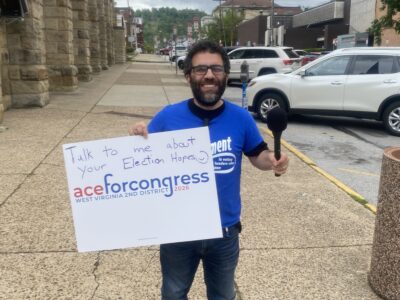
As a Democratic candidate for the U.S. House of Representatives in West Virginia’s District 2, Ace Parsi gets plenty of microphones pointed his way as he touts his platform in a three-person primary race culminating Tuesday.
Yet, on Wednesday afternoon in downtown Wheeling, it was Parsi holding a microphone.
The candidate was talking to voters as they were heading to or leaving the early voting site at the City-County Building, asking them what their concerns were, why they were voting and what issues were most important to them. It’s something Parsi has done throughout his campaign, posting those interviews on his social media.
Parsi is in a primary race against fellow candidates Stephanie Spears Tomana and Steven Wendelin. The winner of that primary faces incumbent U.S. Rep. Riley Moore in November.
“I think what we want to highlight here is that people are worthy of representation,” Parsi said. “Their voices matter. Their problems matter. And increasingly, whatever party you are, you feel like the political establishment is not accessible to you.
“So we want to walk the walk and show that this is what representation should look like in our state,” he added.
Parsi said he’s had conversations with Republicans, Democrats and independents, and he’s found that many of their concerns, despite political differences, often come back to the same subjects. They’re looking for clean drinking water, he said, as well as support for public schools, the improvement in infrastructure and a concern over data centers being built in their communities.
“I think there’s a political talking head culture that makes us feel like we’re actually much more divided than we are,” he said. “And honestly, I think what contributes to that is policymakers that want to inflame these culture wars and never actually care about what people are actually dealing with.”
Parsi’s family fled Iran when Parsi was a child, coming to America and settling in Pennsylvania. His journey ultimately brought him to West Virginia, where he said he felt at home. He most recently served as coalition engagement director for iCivics, a coalition of national groups supporting civics and history education.
“There’s just a basic decency and kindness in the people in this state,” he said. “It’s why people have such an affinity and an identity with the state. West Virginia is the first state I feel a sense of identity, a common identity, with.”
As he wants to represent all West Virginians, Parsi said his platform focuses on affordability, care and empowerment. Among his ideas is a concept of community wealth, like looking at dilapidated buildings and figuring out how they can be renovated and transformed into community centers. He wants to create a “care stimulus,” where people in school to become nurses, social workers, teachers, police officers and other such occupations can get free tuition. And if a data center is being considered in a community, a referendum should precede it.
“What we do in this campaign should make people feel more confident in terms of what actually unites us, and that they’re worthy of having that voice be recognized,” he said.