
A Sampling of Wheeling Preservationists
Trending
(EDITORS NOTE: This is the third article in a series of four that focus on historic preservation during the month of May - Historic Preservation Month. This article features six individuals or couples who are among the many in Wheeling who are actively involved in saving Wheeling's built heritage. Their stories are truly inspiring.)
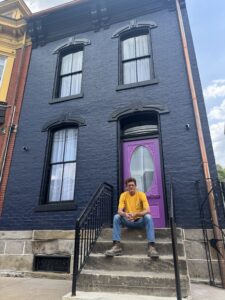
Roger Edwards moved to Wheeling in 2018 after falling in love with the historic architecture while driving through the city during family trips. His home base and work are currently concentrated in the 600 block of North Wheeling, committing to the revitalization efforts in the neighborhood. Roger's specialty is seeing through the detritus and envisioning new life for deteriorated structures, restoring to historical accuracy where possible, and seamlessly unifying all disparate elements. The goal of each project is the living balance of form and function, creating an intimate and livable space that highlights the everyday beauty and details of historic homes that are so often missing in new construction. With nearly 40 years in the construction business, Roger is a one-man wrecking crew. He works on each aspect of his projects solo, ensuring every inch is done correctly and safely and meets his creative standards (and he loves the work). His motto is, "Anything can be fixed," and hopes that more structures throughout Wheeling are restored rather than razed.
Lisa Hrutkay and her husband Tom Fledderus are the owners of 749-753 Main St., also in North Wheeling. They have been residents of the Wheeling/Valley Grove area since the late 1990s, with careers in the medical field. They had enrolled in the Building Preservation and Restoration Program at Belmont College and had taken a few classes before they purchased an historic farmhouse in Valley Grove, which they have spent many years renovating and restoring while living there.
They purchased the buildings in North Wheeling in 2024 with hopes to preserve these riverfront properties for the use of future generations of tenants and restaurant customers. They are currently renovating the restaurant, including teardown and replacement of the entire deck and bar space on the river side of the building and adding wheelchair accessibility. They hope to have that space completed by early fall 2026 as a lasting contribution to the historic character of the city.
Also in North Wheeling, Michele Mayberry is quietly bringing new life to one of the city's historic structures, the Henry K. List House, a building with a storied past that has served as the Lyceum Academy, law offices, and even a chapter of the American Red Cross. Raised in New Hampshire in an early 1800s Federal-style four-square home, Michele developed an appreciation for historic architecture at a young age, a passion first sparked by her father's love of restoration, and was drawn to Wheeling due to its rich architectural heritage and opportunity for meaningful restoration. Now a patent attorney working remotely, she has taken on her first preservation project with determination, aiming to return the house to its original function as a residence. Michele embraces hands-on work, teaching herself skills along the way, including the painstaking repair of damaged Lincrusta, deeply embossed wall covering that had deteriorated due to years without heat and exposure to humidity.
With 23 years in real estate, including investing, owning brokerages, and working in new development, urban planning, and entrepreneurial ventures, Natalie Miniard sees a unique opportunity in Wheeling. She first bought an historic building in Centre Market more than 20 years ago, drawn by the neighborhood's affordability and architectural charm. Since then, her family has moved here, and she has inspired others to invest in Wheeling as well.
Natalie holds a Building Preservation and Restoration degree and is currently working on several preservation projects once deemed beyond saving. She plans to make her forever home in her recent purchase on historic Chapline Street. She's deeply committed to saving Wheeling's historic buildings and saddened by those already lost to neglect and demolition. With Wheeling's central location she sees the city as perfect for those leaving big cities for small-town charm. She reports being thrilled to be part of Wheeling's renaissance and is deeply dedicated to its preservation.
Lane and Carmel Sanders moved to Wheeling from Southern Mississippi two years ago. "We aren’t really sure why we chose Wheeling, sometimes we think Wheeling chose us." Just by chance, they found 219 N. Huron St. online and fell in love, buying the property after only a virtual walk through. They both quickly acclimated themselves to the many local groups dedicated to the preservation and revitalization of the Ohio Valley and have become active volunteers. They have found meeting prior owners of their home to be particularly rewarding. "They continually thank us for saving the house that brought generations of wonderful memories. With a little hard work and a lot of elbow grease, our little house on the Island will be around for many generations to come."
South Wheeling resident Ken Sexton believes that preservation is rarely just about brick, timber or ornate trim. It is about memory, neighborhood identity and whether a community believes its past is worth carrying into the future. Ken demonstrates this belief as part of a growing effort to protect historic buildings from demolition and give old structures another chance.
He has been largely focused in South Wheeling, an area known for its deep immigrant history, industrial roots, and remarkable architecture. Rather than treating old buildings as disposable remnants of another era, he and others argue that many of these properties still hold civic, cultural, and practical value.
The 2022 loss of the historic Hobbs House in South Wheeling caused him to frame the issue not simply as one deteriorating property, but as a broader question of community responsibility: "if local residents and organizations do not step forward for buildings like this, who will?" That spirit would continue through his work as treasurer of Ritchietown Renaissance, the nonprofit preservation group focused on South Wheeling's resources and historic character.
Ken states that preservation is often romanticized, but in reality it depends on money, legal tools, volunteers, and persistence to make restoration and adaptive reuse possible. Under that approach, saving an old building is not just a sentimental gesture. It is an investment strategy for neighborhood stability, local pride, and long-term reuse.
Ken Sexton, Roger Edwards, Lisa Hrutkay and Tom Fledderus, Michele Maybellery, Natalie Minirad, and Lane and Carmel Sanders all represent a kind of local preservationist that many older cities depend on: not celebrity architects or large institutional figures, but residents willing to do the less glamorous work -- attending meetings, rallying neighbors, raising funds, insisting that neglected buildings still matter, investing their own time and money, and quite often getting their hands dirty.
Preserving old houses is about resisting a false choice between sentimentality and progress. Neighborhoods do not move forward only by clearing what is old but also by reusing and reimagining inherited structures that already carry craftsmanship, history, and a sense of place that cannot be rebuilt once lost. A saved house can stabilize a block. A restored commercial structure can attract tenants. A preserved streetscape can reinforce neighborhood identity in ways that demolition rarely does. Preservation matters.
For more information on Friends of Wheeling, visit https://wheelingheritage.org/friends-of-wheeling/.