
Maintaining an Older Home
Trending
(Editor’s Note: This is the fourth in a series of articles celebrating May as Historic Preservation Month)
WHEELING - Maintaining any home - especially an older one - can be very expensive and time consuming. Several local options can be of help. Grants and loans are the first ways that many people tackle funding repairs and upkeep, and Friends of Wheeling, the local historic preservation organization, can sometimes assist.
One of the founders of Friends of Wheeling, Betty Woods "Snookie" Nutting, recently passed away. Donations have been made in her memory for a "Preservation Fund," with the hope that others would add to this gift as a way to continue her legacy to preserve Wheeling's architectural heritage. These funds will then be used to continue the group's Preservation Loan Guarantee Fund and/or to establish a grant fund specifically designated for historic preservation.
The Preservation Loan Guarantee Fund is already in place, having begun in late 2015. Since that time, 28 preservation projects have been helped through low-interest loans that are "guaranteed" with Friends of Wheeling funds. Three examples follow.
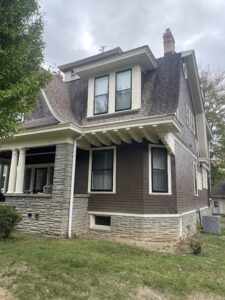
Lori and Bill Carano were among the earliest recipients of a loan guarantee. Lori writes, "Helping my hoarder uncle reclaim his home has been a long but meaningful process for us, one we have been committed to since 2015. Coming from suburban Philadelphia, we traveled every other weekend to sort through years of accumulated belongings, clear out rooms, and begin essential repairs. With the help of our first Preservation Loan Guarantee Fund loan, we had the roof repaired, and a second loan allowed us to hire a painter to repair and paint both the exterior and interior of the house. After years of renting an apartment, the house became livable, and we were finally able to move in temporarily to focus more fully on the work. We refinished the neglected hardwood floors and began furnishing the house, turning it into a comfortable, welcoming place once again. We're excited to make Wheeling our permanent home this summer, with a few more projects planned as we continue turning it into our forever home."
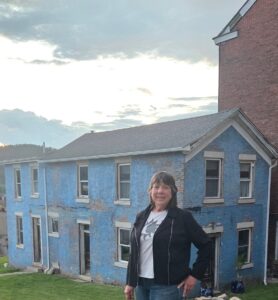
Photo Provided
Low-interest loans and a city grant have helped with renovation of this Market Street home, one of the oldest in North Wheeling.
Another recipient of help through the Loan Guarantee Program was Jackie Herrick, who reported, "When I first saw this house in 2014, it was exactly what I was looking for -- a small brick house needing restoration, with a big yard and a cut stone wall. And it just happened to be in the heart of one of the most historic neighborhoods in America. But, it was built in 1856 and needed new everything -- the kind of house a bank won't touch but exactly the kind of house Friends of Wheeling is here for. My first loan in 2017 paid for the new roof. My second loan in 2022 paid to rebuild the middle section of the north wall that was bowing outward from years of failed box gutters. Also, in 2022, with the money I saved on interest from the loans with Friends of Wheeling, I was able to apply for a façade grant from the City of Wheeling to restore the stone headers and sills and install new windows on the north and south facade walls. This little house is still standing after 170 years, and with their commitment to history, preservation, and restoration, Friends of Wheeling is helping me ensure it will still be standing another 170 years."
The third example illustrates that these low-interest loan guarantees can also be used for commercial properties. Owner Susan Haddad stated, "As a recipient of the Friends of Wheeling's Preservation Loan Guarantee Program, Later Alligator was able to rehab the fire escape stairway and second floor porch. The 1869 building underwent a near total renovation during the three years prior to the restaurant opening in 2006, and with the Preservation Loan Guarantee, we were able to go full circle and complete the project. As owner of Later Alligator, I have long been interested in restoration and renovation. I lived in the old Clinton School House on Rt. 88 in Triadelphia for 19 years before moving to Wheeling's Victorian Main Street where I've been since 1989. Both houses have undergone major renovations to their exteriors and interiors."
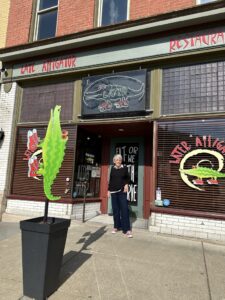
Photo Provided
Owner Susan Haddad poses in front of the popular Later Alligator restaurant, one of the recipients of a Preservation Loan Guarantee from Friends of Wheeling.
Other projects benefitting from the low-interest loans have included roof replacements, painting, and general interior and exterior rehab work. Loans of up to $30,000 are currently available. More information on this program can be found at: https://wheelingheritage.org/friends-of-wheeling/.
Competitive grants are also a possibility, with most requiring matching funds to any awards that are made. Preservation Alliance of West Virginia is soliciting proposals for rehabilitation of properties built before 1871, with a proposal due date of July 31. Details can be found at: https://www.pawv.org/savingplacesgrant.html. And, the WV State Historic Preservation Office offers annual grants. See: https://wvculture.org/shpo-grants/state-development-grant/.
In prior years, the City of Wheeling has also assisted with rehabilitation projects. Grants of up to $5,000 were made available at one point, and Facade Improvement grants helped with work on the exteriors of commercial structures and homes in the city's three Design Review Districts. Both programs were well-received and very effective.
Last year, a sister preservation organization, Ritchietown Renaissance, coordinated a "Care & Repair" program that assisted homeowners with minor repairs, using volunteer labor and funding for materials from Volunteer West Virginia. Recipients qualified for the program by being elderly, low-income, veterans, disabled, and/or flood victims. Project Coordinator Debbie Griffin reported, "We served 12 households in our target area of South Wheeling, East Wheeling and Wheeling Island as well as two flood victims. Work ranged from painting, drywall repair/replacement, window repair, door replacement, porch step repair, bathroom refurbishment, yard cleanup, and other projects." "This is the best day of my life!" was the reaction of a 10-year-old boy who was taught to use a paint roller and helped paint his own bedroom.
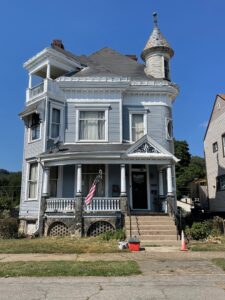
Photo Provided
Exterior painting was done on this lovely Wheeling Island home through the "Stronger Together 9-11 Care & Repair" project coordinated by Ritchietown Renaissance.
The group also helped to convert a first-floor room into a bedroom, enhanced kitchen lighting, hung a storm door, and replaced a missing window for another homeowner. She stated, "I am just so grateful to have come across this program. It has put a light at the end of my tunnel because I am a senior citizen trying to stay in my home. And with this help, it has made my house safer and made me more able to live a healthier life in my own home. It speaks volumes about what we can do as a group."
Unfortunately, this project wasn't funded again, and the city programs are also not currently available. Donations to help with projects such as these can be sent to Friends of Wheeling, P.O. Box 889, Wheeling, WV 26003, with a Preservation Fund memo. Or electronically at: https://www.zeffy.com/en-US/donation-form/preservation-fund.
Wheeling is fortunate to have a legacy of historic structures that are worthy of preservation -- substantial, quality buildings that most other cities don't have. The examples in this article and in the three previous articles are inspiring views of what can happen when property owners, preservation advocates, and government all work toward reuse instead of removal, with historic buildings seen as assets with future potential, not as liabilities.