
Morrisey Defends Religious Vaccine Exemptions In W.Va. Supreme Court Filing
Trending
CHARLESTON - Gov. Patrick Morrisey said his executive order creating a pathway for religious exemptions to West Virginia’s compulsory vaccine law for school-age children is protected by existing religious freedom laws.
In an amicus brief filed Monday with the West Virginia Supreme Court of Appeals, attorneys for the Governor’s Office argued that the Equal Protection for Religion Act allows for religious exemptions for school vaccine mandates despite the exemption itself not being part of state code.
"West Virginia law protects religious freedom, and that law must be followed," Morrisey said in a statement Monday morning. "Parents should not be forced to choose between their sincere religious beliefs and their child's right to an education. The Equal Protection for Religion Act is clear, and my administration will continue fighting to ensure that religious liberty is respected across state government."
The brief also argues that the state Board of Education acted unlawfully by directing schools to ignore Morrisey’s Jan. 14 executive order.
"The order directed officials at the Department of Health to establish a process for seeking a religious exemption to the vaccination requirement," wrote Holly Wilson, principal deputy solicitor general for the state Attorney General’s Office. "The Department complied, and it began issuing religious exemption letters to a small group of families. Children enrolled and attended for the Spring 2025 semester.
"Yet the State Board of Education decided it knew better," Wilson continued. "It refused to honor exemption letters, and it issued a statewide directive instructing every county school board to disregard them. It declared that religious exemptions were categorically impermissible. In doing so, the Board ignored EPRA, the Governor's order, and the harm inflicted on religious students and families."
State code requires children to be vaccinated against diphtheria, pertussis, tetanus, polio, measles, mumps, rubella, varicella and hepatitis B unless they have been granted a medical exemption. Morrisey cited EPRA - created by House Bill 2042 in 2023 to prohibit excessive government limitations on the exercise of religious faith - as allowing him to use his executive order authority to create a religious vaccine exemption.
Despite the West Virginia Legislature not passing a bill to codify a religious vaccine exemption in 2025, Morrisey said his executive order allowing religious exemptions was still in effect and his office provided additional guidance to the Department of Health and to the public on how to request a religious exemption. But the state Board of Education issued guidance through the Department of Education to county school systems to continue to abide by existing state code and not honor religious vaccine exemptions.
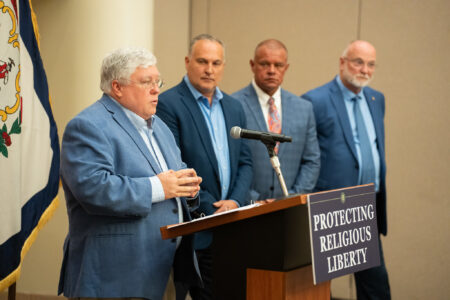
Raleigh County parent Miranda Guzman and other families with children in Raleigh County Schools filed suit against local and state education officials in June 2025 asking 14th Judicial Circuit Judge Michael Froble to grant a preliminary and permanent injunction against education officials to require them to accept the granted exemptions. Morrisey attended a press conference announcing the lawsuit and expressed his support.
Froble granted both the preliminary injunction that summer and a permanent injunction in November, as well as certifying the Guzman case as a class action that applied to families with religious vaccine exemptions statewide except those with pending cases before other circuit court judges. The state Board of Education and the Raleigh County Board of Education appealed these rulings to the state Supreme Court.
In the amicus brief filed Monday, the Governor’s Office argues that EPRA supersedes conflicting statutes and that the government entities fail strict scrutiny by denying religious accommodations while allowing medical ones. The brief also argues that Morrisey exercised valid constitutional authority when he ordered the Department of Health to develop an exemption process.
"Three years ago, the West Virginia Legislature enacted the Equal Protection for Religion Act," Wilson wrote. "That statute commands that no government action may substantially burden sincere religious exercise without satisfying the most demanding scrutiny the law allows or ‘[t]reat religious conduct more restrictively than any conduct of reasonably comparable risk.’ EPRA is not aspirational, and it is not a policy preference. It is the law of West Virginia, duly enacted and binding on every state actor.”
Attorneys for the state and local education officials are seeking oral arguments before the state Supreme Court, asking the justices to reverse Froble's permanent injunction ruling and order Froble to enter a judgement in their favor, or vacate Froble's ruling and remand the case to the lower court for appropriate evidentiary development.
Attorneys representing the Guzman plaintiffs have until the end of the day Monday to file their brief in the case, with education officials' attorneys having until June 1 to reply.
"This case is not about whether vaccines are effective or whether families may choose them," Morrisey said. "It is about whether the government can ignore a law designed to protect sincere religious exercise. West Virginia must be a state where families of faith are not pushed out of the classroom because they exercised rights protected by law."