
Feds Looking Into Grant Misuse on Flood Recovery
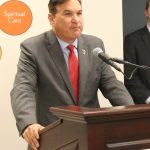
Photo by Steven Allen Adams U.S. Attorney Mike Stuart speaks at a substance abuse press conference in December.
CHARLESTON — The U.S. Attorney’s Office for the Southern District of West Virginia is looking into the use of federal disaster recovery funding for the 2016 flood and whether those dollars were appropriately used.
U.S. Attorney Mike Stuart released a statement Wednesday saying his office is looking into abuse of grant funding sent to West Virginia by the U.S. Department of Housing and Urban Development and the Federal Emergency Management Agency to help affected residents recover and rebuild from the 2016 storms.
“Every available dollar for disaster relief must be spent on disaster relief. Diversion, fraud, corruption or delay cannot and will not be tolerated,” Stuart said.
“West Virginians need to be reassured that federal law enforcement is now investigating this matter,” Stuart said. “Rest assured, my office is working with appropriate federal agencies to investigate the issues of disaster relief, and use of federal funds related to the historic 2016 floods and I can assure our citizens that any party that abused their position of authority, violated the public trust, or misused taxpayer dollars will be held accountable, if warranted.”
According to the National Weather Service, the state in June 2016 experienced a flood of the magnitude that occurs once in 1,000 years. Some parts of the state had 10 inches of rain in a single day.
The storm causes severe flash flooding in Kanawha, Nicholas, Webster, Summers, Roane and Greenbrier counties. The flooding killed 23 people and swept away homes and trailers.
“The deadly 2016 floods were a seminal event for West Virginia,” Stuart said. “Too many of our precious citizens lost their lives. Many other lives were terribly impacted. Critical infrastructure including roads, bridges, and water systems were destroyed or significantly interrupted. And too many West Virginians lost their most critical personal asset – their homes. Many lives were literally turned upside down. To this day, the future remains uncertain for too many of our friends and neighbors.”
West Virginia has received more than $213 million from FEMA’s individual assistance, public assistance and hazard mitigation programs for the 2016 flood. HUD sent $149 million for 2016 flood disaster recover with another $106 million on the way.
“Post-disaster, the federal government committed millions of taxpayer dollars to disaster relief for recovery with the intent that the assistance would help rebuild lives and rebuild communities,” Stuart said. “Critical federal resources through FEMA and the Department of Housing and Urban Development are essential to the rebuilding process and must be used wisely, timely and legally.”
The HUD and FEMA grant programs have been in the headlines over the last 12 months due to missteps and misuse.
In February 2018, HUD granted spending approval through the RISE West Virginia program managed by the state Department of Commerce for the renovation, demolition and reconstruction of new homes, as well as replacement of trailers in areas hardest hit by the 2016 flood. The governor paused RISE shortly after the approval.
Months later, legislative auditors found that RISE entered into six illegal contracts with a disaster management firm totaling $18 million. Commerce also entered into seven contracts with four construction companies for more than $71 million that were awarded before HUD approved use of the funds.
Several commerce department officials were fired or resigned in the wake of the RISE controversy, including former Commerce Secretary Woody Thrasher. The West Virginia National Guard was put in charge of the RISE program in June 2018 and the program resumed.
In March, the State Auditor’s Office released a report citing misuse of FEMA grants by the Town of Richwood meant for helping the town rebuild after the 2016 flood. Four current and former Richwood officials were charged with allegedly embezzling FEMA grant dollars and misuse of state purchasing cards.
The town received more than $3.1 million in FEMA grants, which the state Division of Homeland Security and Emergency Management was supposed to monitor. Auditor’s specifically cited the use of $500,000 to repair the town’s water intake. Instead, $400 was used for a cheap fix, with the remainder of the grant going toward the salaries of city officials and city debts.
“Desperate communities and West Virginians depend on critical, limited dollars to assist in recovery,” Stuart said. “Desperate communities and West Virginians need certainty that in a future disaster intended assistance will be delivered timely and spent properly.”
Top Headlines
Stonemile Group In Negotiations For Gateway Center Construction Contract
The latest step in the construction of the Wheeling Gateway Center was announced Monday, as the Wheeling-Ohio ...
Oil Prices Rise As War Drags On, But Stocks Inch To More Records
NEW YORK (AP) — Oil prices rose Monday as the war with Iran threatens to drag on for longer, but the U.S. stock ...

Site Plan for WVU Regional Cancer Center Approved
Morrisey Defends Religious Vaccine Exemptions In W.Va. Supreme Court Filing

Justice Attorneys Seek Stay Of Federal Greenbrier Lawsuit
West Virginia Voters Cast Primary Ballots Today
WHEELING — Today is Election Day for West Virginia voters, though if local early-vote numbers are any indication, ...